



OFF THE SHELF: SEPTEMBER 2026
HEDGELAYING AT HARCOURT ARBORETUM
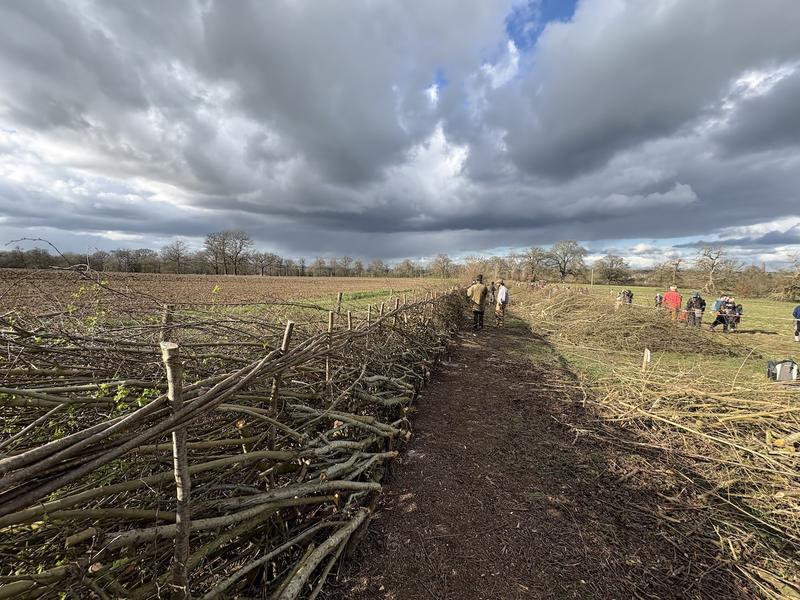
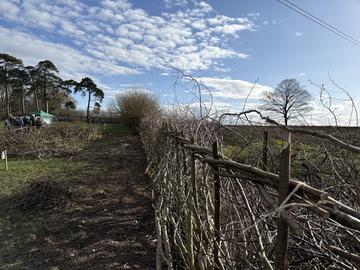
The last day of meteorological winter, 28 February, saw 36 novice hedge layers practise their art on a mature, native English hedge at the University’s Harcourt Arboretum in Nuneham Courtenay, six miles outside Oxford.
The competition involved both singles and pairs working to two regional styles, the South of England style and the Midland style.
Hedge laying is a traditional countryside management technique used to rejuvenate hedgerows. It involves partially cutting through stems near ground level (‘pleaching’) and carefully bending and weaving them along the hedge line while keeping them alive. This encourages vigorous regrowth from the base, creating a dense, living boundary. The work is normally performed between 1 October and 31 March.
Historically, many different regional styles flourished in accordance with landscape and livestock. Oxfordshire spans Midland and Southern styles, both of which were designed to provide farmers with stock-proof field boundaries, suitable for both beef herds and sheep respectively.
Superficially similar, the two styles have distinct traits. The Midland style is cut close on one side, and left bushy on the livestock side, while the Southern style is trimmed but left bushy on both sides, so-called ‘double-brush’.
The way the binders are woven, the long, slender hazel limbs that interweave vertical stakes placed at 45cm intervals amidst the pleached hedge, is also distinct for each style, the Midland or ‘bullock’ hedge involving a robust, ‘rope’ weave.
Participants were given five hours to lay between 7 and 8.5 metres of hedge, and without the permitted use of chainsaws had to display axe and billhook skills to achieve the precise ‘pleaches’ that are a major part of the aesthetic in a competition.
The event was delivered in partnership with CPRE (Campaign to Protect Rural England) Oxfordshire and Wild Oxfordshire as part of their Oxfordshire Hedgerow Heroes project, which launched in 2021 to increase local hedgerow knowledge across Oxfordshire.
Ben Jones, the Arboretum Curator at the University of Oxford’s Harcourt Arboretum, says: ‘It was hugely encouraging to see 36 competitors working together to rejuvenate a traditional English hedgerow, alongside almost 1,200 visitors who came to watch and learn throughout the day. Hedge laying is a traditional, practical conservation skill that delivers ecological benefits while preserving an important part of our rural heritage.
At Harcourt Arboretum we are committed to demonstrating how historic land management techniques remain highly relevant to modern nature recovery, improving habitat structure, connectivity, and long-term landscape resilience. The enthusiasm from participants and visitors alike shows a growing appreciation for hands-on conservation, and we hope this marks the beginning of a recurring regional event celebrating hedgerows and the skills needed to care for them.’
Jessica Bouwer, Hedgerows and Partnerships Officer for Wild Oxfordshire, says: ‘The idea for a novice hedge laying competition stemmed from Nigel Adams’ Four Counties Hedge Network (4CHN) group and Wild Oxfordshire, aiming to draw together organisations and individuals with interest in hedgerow conservation and management from across Oxfordshire, Berkshire, Buckinghamshire and Gloucestershire.
The competition was a huge success! The hedge layers had an exhausting but exhilarating day rejuvenating 180m of hedge collectively in just five hours. All the competitors should be extremely proud of what they achieved. We hope this event delivered by Wild Oxfordshire and Nigel Adams in partnership with Oxford University gave novices the confidence to participate in future competitions, which not only helps hedgerows thrive within the landscape but allows competitors to improve their abilities in this rural craft.’
Professor Simon Hiscock, Director of Oxford Botanic Garden and Arboretum, says: ‘Hedgerows are one of the defining features of the British landscape, supporting biodiversity while reflecting centuries of land management tradition. Hosting the hedge laying competition at Harcourt Arboretum allows us to celebrate an important traditional rural skill, demonstrate practical conservation in action, and help visitors understand how traditional techniques continue to play a vital role in nature recovery today.’
HM King Charles III is both the patron of the Oxford University Botanic Garden and an accomplished hedge layer.
It is envisaged now to hold a recurring annual event at different hedgerow sites across the Oxfordshire region.
move to carousel movement controls
 Pause slideshow
move to carousel content
Pause slideshow
move to carousel content

ELLA BARON
ELLA BARON

THE IMPORTANCE OF VACCINE ADVOCACY
THE IMPORTANCE OF VACCINE ADVOCACY

SILICON VALLEY CAREER TALK
SILICON VALLEY CAREER TALK

DEGREES WORTH IT AFTER ALL
DEGREES WORTH IT AFTER ALL

OFF THE SHELF: AUGUST 2026
OFF THE SHELF: AUGUST 2026

THE RISE OF BACTERIAL RESISTANCE FROM POULTRY FARMS
THE RISE OF BACTERIAL RESISTANCE FROM POULTRY FARMS

NATURAL HISTORY AT OXFORD REVAMPED
NATURAL HISTORY AT OXFORD REVAMPED

OFF THE SHELF: JULY 2026
OFF THE SHELF: JULY 2026

MALACHI MCINTOSH
MALACHI MCINTOSH

EBOLA: FIRST VACCINATION
EBOLA: FIRST VACCINATION

GRAPPLING WITH THE GHOSTS OF CARIBBEAN COLONIALISM
GRAPPLING WITH THE GHOSTS OF CARIBBEAN COLONIALISM
Pause slideshow

