



SARAH RUDEBECK
WOMEN’S RUGBY 2026
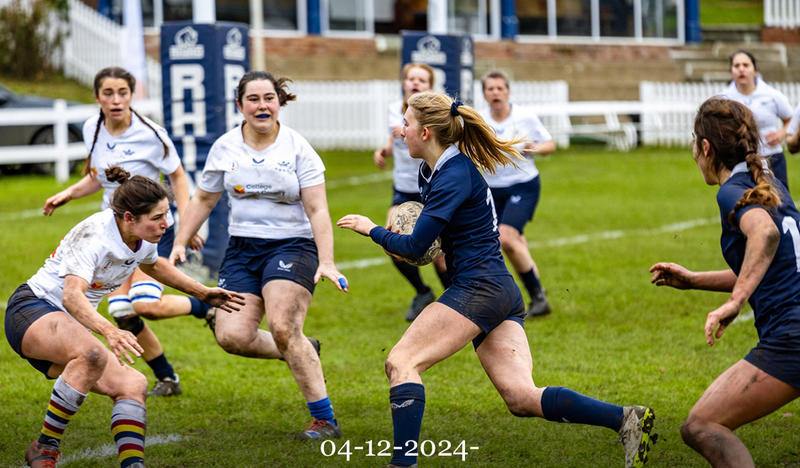
As the 2026 Varsity Matches draw closer and preparations are underway, the coming weeks present us with the perfect opportunity to reflect. Varsity is at the heart of Oxbridge rugby; it reminds us of our community and invites us to truly consider what it means to be a Dark Blue. With this, a crucial part of looking forward to Varsity is therefore the act of looking back – of delving into the history of the club, and remembering the steps taken by players before us that have led us to where we stand today. OURFC is brimming with the stories of individuals who have shaped the club into the community we know and love.
This season, after a year buzzing with the success of female sport, we turn our focus to the tale of Women’s Rugby at Oxford University, which began with the formation of Oxford University Women’s Rugby Football Club in 1988 (OUWRFC).
The original Oxford University Rugby Football Club (OURFC) was founded in 1869 and is one of the oldest rugby clubs in the world. But when the men’s inaugural Varsity Match took place in 1872, it would be more than 100 years until the Women’s Blues first faced Cambridge, in March 1988, the first ever women’s Varsity rugby match. It would then be nearly three decades before the merger in 2015. Since then there has been just one club, OURFC.
Last season I had the honour to speak to the first Women’s Captain and Founder of OUWRFC, Heather Bunting (now Lawrence; St Catherine’s, 1981). At the hallowed turf of Iffley Road, I learnt the remarkable story of how the Women’s Varsity Match came to be.
The official establishment of women’s rugby in the UK began to take shape in the late 1970s. The Women’s RFU was set up in 1983, which was very soon after Bunting arrived in Oxford. She matriculated in 1981 to study Chemistry at St Catherine’s College, before pursuing a DPhil at St Hugh’s College. A natural athlete, she earned her first Half Blue in karate in 1986 and then captained the team in 1987. Bunting’s interest in rugby took flight when she saw a poster for the Oxford Old Boys Rugby Club, which was recruiting female players. She joined, learnt the game, and eventually competed in tournaments across the country with the Old Boys, or ‘Old Belles’ as the women’s team called themselves. Bunting soon decided it was high time to establish a University side. So, she set out to recruit players. Originally, Bunting simply approached women spectators at the Men’s Blues matches and asked them if the sport was something they’d consider playing themselves. She later gained students at the 1987 Michaelmas Freshers’ Fair.
I asked Bunting if it was difficult getting women involved, to which she responded that mostly it wasn’t – those who were interested immediately enjoyed the game and committed their time to it. Training sessions at the University Parks became a regular fixture; Bunting recalled that ‘the forwards just loved it’, as well as their winger Anna Spash’s (St Hilda's College, 1986) delight at being ‘allowed’ to go out and get ‘covered in mud’. She also detailed spending hours in the Parks practising kicking over the posts with Clare Campbell-Smith (St John's College, 1986), who would later start as fly-half for Oxford and convert the team’s first Varsity try. These were the early days of OUWRFC, but momentum was already building. Big things lay ahead of this team.
Bunting’s plan to organise a Varsity Match advanced from a chance conversation in a pub in Cambridge, in April 1987. After having agreed to drive a group of cricketers to the Other Place for a game, she found the topic had turned to women’s rugby. It happened that Cambridge University had female players of their own, one of whom was promptly summoned to the pub to meet with Bunting. Planting the seed for the rivalry that would soon take shape, the two got to talking, and it was decided that their budding sides would play each other for the first time in history.
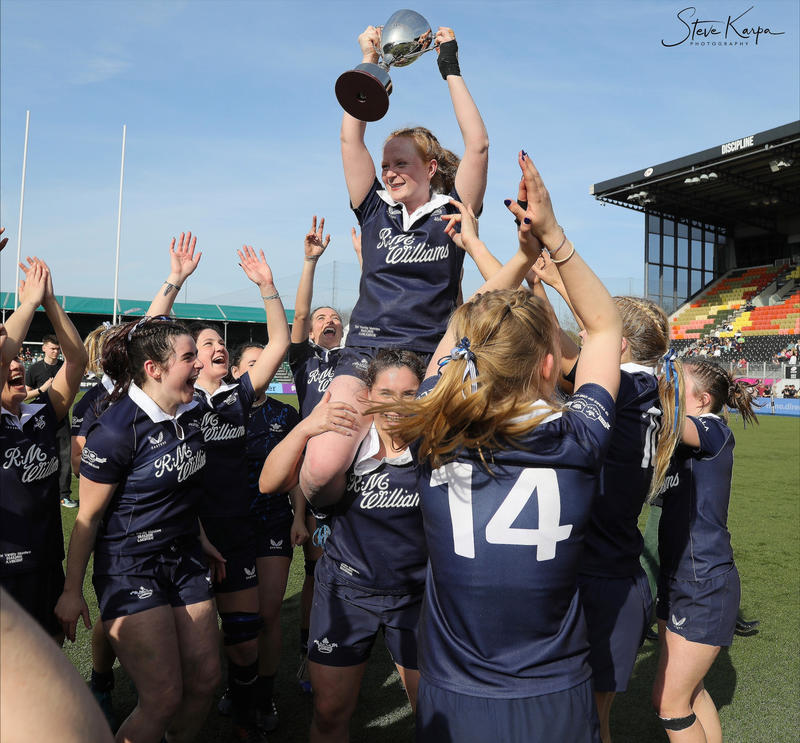
This, however, was easier said than done, and the girls faced many challenges – when and where would they play? What kit would they wear? How would they get the support they needed? OURFC was not obstructive, Bunting said, though she did remark that she never asked for anything she knew she wouldn’t get. The growing Oxford Women’s team did not disrupt the men’s schedule by training at Iffley; all they requested was that the match be played there, Cambridge University Rugby Union Football Club (CURUFC) not yet allowing a women’s game to take place at Grange Road. OURFC obliged, and then the rest was almost all done by their own hand.
To this end, Bunting and her team dedicated hours to fundraising, creating and distributing leaflets, and of course, training. And then there was a question of kit. In the end, the Oxford women were given the Men’s 2nd team shirts, because they were slightly smaller than the Blues’ kit, and still Dark Blue. Cambridge, on the other hand, had been denied access to kit by CURUFC, and had to look elsewhere. They instead found red and blue striped jerseys that the father of their captain, Sophia Pegers (now Mirchandani) had managed to attain through sponsorship by Kent and Curwen.
Meanwhile, the clubs and committees began to take shape. A series of hand-written correspondence unfolded between Bunting and the Cambridge secretary, as they worked to finalise a match date. Originally, the two teams had aimed for a December fixture to align with the men’s game, though ultimately Cambridge requested a later date, claiming that they would not be ready by then. An agreement was eventually reached: the women’s inaugural Varsity Match would be held on 10 March 1988 at Iffley Road. It would take place on a Thursday afternoon, so as not to disrupt the men’s training sessions on Wednesday and Friday.
Bunting eagerly described a distinct memory from that day. She remembered very clearly feeling a mixture of relief and excitement when the Cambridge bus ‘actually pulled into Iffley Road’ that morning, their women and coach on board: 'I remember thinking, "this is it, this is actually going to happen."' And so it did.
Cambridge were the first to make it over the line, with a try from their winger, Barbara Skelly. Soon, her Oxford opponent Anna Spash would make an excellent interception on the wing to equalise for Oxford, which was described by the Oxford Mail as a ‘try that would have graced any match’. Her effort was converted by fly-half Campbell-Smith. After an intense 80-minute battle, the game resulted in a narrow victory for Cambridge – they won with 8 points to 6, sealed by a last-minute try from a scrum on the 5-metre line, touched down by their flanker and captain, Sophia Pegers.
The event was a triumph, generating a small crowd and even some press. David Hands, rugby correspondent for The Times had attended the game, and wrote a feature that appeared in the paper the next day. Recognising the historical importance of the first women’s rugby match between the two universities, Hands wrote: ‘They worked hard to organise it, they worked even harder during it, and both sides and their coaches (male) deserve immense credit for an afternoon spilling over with enthusiasm.’
Bunting recalled that there was a fair amount of discourse at the time, some kind, some less so. The team paid little attention: ‘We just thought that the most important thing was to play the game.’ A game that was new to them, but evidently very exciting, and one that they continued to pursue despite all its challenges. Bunting observed that because of the extra effort being a Women’s Blue required, the players gave up almost all of their free time to play rugby. But they did so for good reason. She explained that amongst all the hard work, the critics, and the commentary surrounding the women’s game, one thing persisted beyond the noise: joy. This was a word that the former captain kept coming back to. For Bunting, it was a ‘joy’ to play, a ‘joy’ to watch the women’s game grow in the years that followed, as it is a ‘joy’ to frequently return to Oxford and see the women’s team thriving today.
This is a feeling that has cascaded down generations. Though we still live in a world where women’s rugby faces discrimination, it is joy that brings us to training, and that motivates us to support one another. Our love of the game rises beyond the adversity. The article in the 1988 Oxford Mail stated: ‘In sporting fashion, both teams cheered and applauded each other off the pitch. Heather [Bunting] said that was the nice thing about women’s rugby.’
Because of course, this joy is something that all of us share. The women of Oxford and Cambridge are part of an ancient rivalry that is also uniquely bonded. These historically opposing teams are brought together by our proud history of determined women. It is something that cannot be undone, no matter the scoreline. The women’s game is extraordinary in this way, because every match is meaningful. Whether on a grassroots pitch or an international stage, every pass, every tackle, every try is proving the same point now as it did in 1988: it proves that women want to, can, and will play rugby.
And it is ever-expanding. Globally, female participation levels have reached an all-time high, with now over a quarter of all rugby players being female.
These numbers are skyrocketing after the Women’s Rugby World Cup in 2025, which England won at Twickenham in a match against Canada. The tournament brought home more than a shiny trophy – it generated sold-out stadiums, record-breaking crowds, and solidified a generation of female athletes for the next one to look up to. The Oxford Women’s Blues went together as a team to the historic final, lucky enough to experience the sensation first hand.
‘I think it’s phenomenal the way [women’s rugby] has grown,’ Bunting told me, and added that for her there was almost a degree of incredulity with how quickly the women’s game has developed.
When the Women’s Blues take to the pitch at StoneX on Saturday 28 February, they will embody this growth. 38 years after its first iteration, the Women’s Varsity Match isn’t positioned according to the Men’s training schedule, but instead opens the day’s competition at the home stadium of a Premiership Side.
So while we look ahead to Varsity, the Women’s Blues of 2026 maintain the immense sense of honour that it is to be a part of this history. And as for Game Day itself, our original Captain imparts her own pre-kick off advice: ‘You’ve put the work in, now go and get the result,’ she implores the Blues. She reminds us not to let nerves get in the way of our play. ‘There’s only 80 minutes between you and the win.’
Ultimately, as we don our own Dark Blue jerseys and run out of the tunnel alongside our opponents, we will remember how we stand on the shoulders of the students who came before us. We will play with pride, representing those who have built our club piece by piece, to bring it to the wonderful display of women’s sport it is today.
move to carousel movement controls
 Pause slideshow
move to carousel content
Pause slideshow
move to carousel content

OFF THE SHELF: SEPTEMBER 2026
OFF THE SHELF: SEPTEMBER 2026

ELLA BARON
ELLA BARON

THE IMPORTANCE OF VACCINE ADVOCACY
THE IMPORTANCE OF VACCINE ADVOCACY

SILICON VALLEY CAREER TALK
SILICON VALLEY CAREER TALK

DEGREES WORTH IT AFTER ALL
DEGREES WORTH IT AFTER ALL

OFF THE SHELF: AUGUST 2026
OFF THE SHELF: AUGUST 2026

THE RISE OF BACTERIAL RESISTANCE FROM POULTRY FARMS
THE RISE OF BACTERIAL RESISTANCE FROM POULTRY FARMS

NATURAL HISTORY AT OXFORD REVAMPED
NATURAL HISTORY AT OXFORD REVAMPED

OFF THE SHELF: JULY 2026
OFF THE SHELF: JULY 2026
MALACHI MCINTOSH
MALACHI MCINTOSH
EBOLA: FIRST VACCINATION
EBOLA: FIRST VACCINATION
Pause slideshow

