
CHRIS MITCHELL
CHRIS MITCHELL
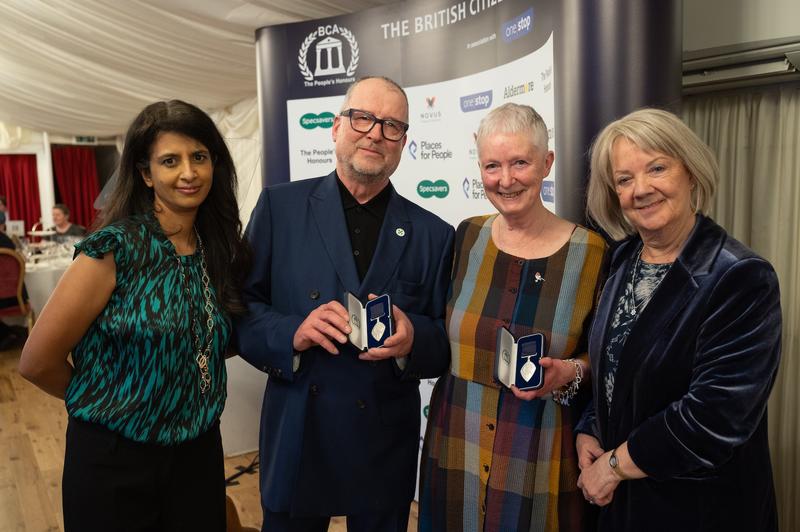
Chris talks about receiving, with his wife Denise, a richly merited British Citizen Award
Published: 18 March 2026
Author: Richard Lofthouse
Share this article
The first thing Chris Mitchell BCAc (Wadham, 1974) said to me is that the British Citizen Awards he and his wife Denise Mitchell BCAc each received in January are more deservedly hers than his.
Still together despite having met in their schooldays – he at Marling Boys’ Grammar School near Stroud, Gloucestershire, she at Stroud Girls’ High School – the couple, both 70, were recently awarded the British Citizen Award for Service to the Community (post-nominally, BCAc).
The honour was bestowed in recognition of their exceptional work with children with special needs.
‘We said back then, if we could have our own children we would help others too,’ he explains.
This duly happened – two sons of their own, Will and Joe, and adoption of three babies with Down’s Syndrome, two sisters and their brother, now 40, 37 and 26 respectively.
But this wasn’t all. Denise, originally a nursing assistant in an independence training ward of a Learning Disability hospital, and Chris, who for a long time worked as a social worker with vulnerable adults, then decided that they would also go on to foster neo-natal babies, straight from hospital, typically under six weeks old, and in need of a home.
‘This was Denise's career, in effect. We did it for 12 babies at typically one year for each, plus a couple of short-term placements.’
‘There is now ante-natal screening in place, but historically children with Down’s Syndrome account for 1 in 100 live births. There is a Down's Syndrome Society and there has always been plenty of information there.’
Proud though they are of their award, which was presented at the Palace of Westminster, Chris remains completely enthusiastic about the whole experience of adopting and fostering.
‘It’s been a lot of fun…’ he says. ‘It doesn’t matter who you are. There are kids desperate for a family setting. You should consider it!’
The Wadham connection remains strong. ‘I read Modern History with Pat Thompson [A F Thompson] and Cliff Davies. I was part of the first year in which women came, in 1974! The Wadham vibe is so inclusive, and that’s what I’ve been about all these years, doing what I can to support people with additional needs and to get them included in a caring and supportive community.’
Sometimes referred to as ‘the People’s Honours’, the BCAc is awarded to individuals who strengthen their communities through sustained commitment and care, frequently without public recognition, and whose contribution has made a meaningful difference to the lives of others.
Their recognition places them among a select national group of 630 BCAc recipients whose efforts are described by the awards body as those of ‘pillars of their local community’ – individuals relied upon by others and trusted to make a difference in challenging circumstances.
For Wadham and the wider University community, Chris and Denise’s awards are a reminder that impact is not measured only in professional achievement or public profile.
Chris looks back at a long career as a social worker, that began with a Certificate of Qualification in Social Work gained at Cardiff University following Oxford, 1977-79.
He is optimistic despite worrying greatly about current headwinds in the UK public sector and caring communities.
‘When I started in autism 20 years ago, the ratio of diagnosed autistic women to men was 1:15. That terribly skewed diagnosis was because women are better at masking the condition, partly through how they have been conditioned to cover their needs by society. The neurodiversity agenda has come a long, long way since then, with vastly better inclusion whether measured by educational attainment or other indicators.’
Chris says that a major challenge to the sector is a recent fall in the number of fostering households and carers. According to CommunityCare, the number of fostering households in England fell by 10.4% in the period 2021-25, with the number of approved carers dropping by 11.8%, from 63,890 to 56,345.
In February, the Department for Education (DfE) launched an action plan designed to create 10,000 more fostering places by 2029.
Still dedicated to his original interest in the field of history, Chris now works as a guide at nearby Haddon Hall, ‘a still privately owned medieval courtyard house that too often gets overshadowed by Chatsworth!’
Remaining in close touch with his college, he fondly recalls participating in its annual reading party led by Dr Ray Ockenden, in Cornwall. Dr Ockenden is today an Emeritus Fellow of Wadham, and was the college’s first Fellow in German in 1967.
The British Citizen Awards (BCA) are administered by The People's Honours, a privately held organisation founded in 2012 to recognise individuals for exceptional community contributions. The awards, which include categories for volunteers and youth, are assessed by an independent panel, with ceremonies held bi-annually at the Palace of Westminster.
Chris encourages anyone interested in fostering to visit the Fostering Network.
Image shows: Konnie Huq, Christopher Mitchell BCAc, Denise Mitchell BCAc, Dame Mary Perkins (Specsavers) at the award ceremony earlier this year. Credit: BCA