
HOLLY ELLIS
'DON'T PANIC': ALUMNA CARYS HOGGAN ON LIFE AFTER OXFORD
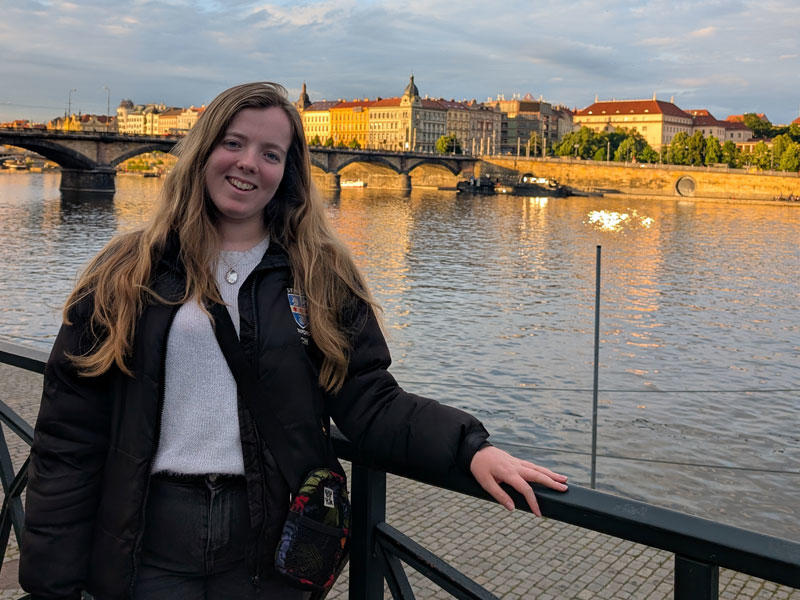
Carys Hoggan graduated from Oxford in 2024 with a BA in Psychology, Philosophy and Linguistics. She completed a master’s degree a year later at the University of Liverpool, where she is now pursuing a PhD in psychology. Carys has long been passionate about equality, diversity and inclusion (EDI) – alongside her research, she advises government on education policy and has spoken to MPs about improving provision for students with special educational needs and disabilities (SEND).
We talked to Carys about life after Oxford, the skills she’s carried forward, and why you don’t need to have everything figured out when you graduate.
How would you sum up your Oxford experience?
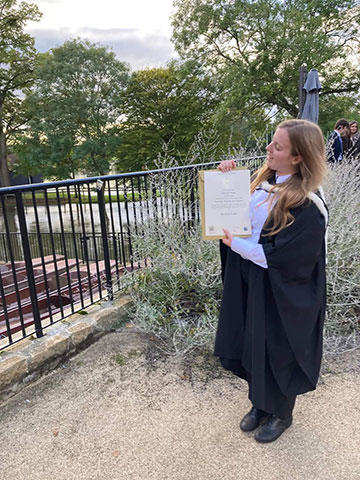
Oxford is a whirlwind of three years. I loved my time at St Hilda’s, the community there is just amazing. I'm still in contact with a lot of my friends from the college and staff members that I met while I was there too, which is really lovely.
I think by the time it came to the end of my degree – aside from being tired from the exams – I knew that the skills I had gained were always going to be useful for me and that Oxford was always going to be somewhere where I felt like I was at home.
How did you find the transition from Oxford life to post-graduation?
One of the things that I found difficult was not having people in the same place as me – you leave Oxford and suddenly you've gone from all being together (at least for half of the year), to some of you having moved to other countries. I had to be much more conscious about asking: have I seen or spoken to this person recently? I should send them a message and see how they're doing.
Also, having stayed in postgraduate study, switching my mind to what things would be like at a different university was a challenge. By the time I got to the end of my three years at Oxford I was an expert on writing essays: you ask me to write 2,000 words and I'll get it done for you very quickly and have a lot of fun doing it! And then having to go to a different uni, where they have a different style of assessment and different things they’re looking for… I found that quite difficult.
And obviously, I knew that I was going to miss the beautiful buildings, my little nighttime walks past the Sheldonian listening to whatever they had on that day, my late-night trips to G&Ds with friends… all the typical things combined with the fact that I knew it was the end of an era.
What skills from Oxford have been most useful since graduating?
Critical thinking is a huge one. You learn very, very quickly not take things at face value – Oxford trains you to question things at their very core.
I also think you can't hide at Oxford. In tutorial sessions there might only be two of you, and I've had tutorials where it’s just been me. This has served me so well going into my PhD, where I have to be able to argue my case or take another theory and pull it apart and say why I think it’s wrong or how it could be done better.
So I think those – along with the networking and being confident working with a wide variety of people – are really important skills that I've taken with me.
You’ve been involved in EDI and youth activism for many years – how did you get started, and what are you focusing on at the moment?
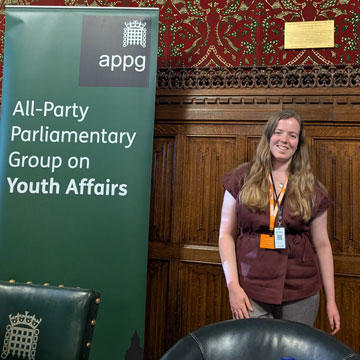
A lot of it primarily comes from the FLARE (Friendship, Learning, Achieve, Reach and Empower) group, which is essentially a national advisory group to the Department for Education. I’ve done it for probably 10 years now, so before I joined Oxford.
This has culminated in the schools white paper, Every Child Achieving and Thriving, which was published in February. The government is currently at the stage of asking people for their feedback and we’ve been helping them come up with the questions for the consultation, as well as to think about how they can get as diverse a range of young people as possible to participate as the paper contains a lot about how SEND provision will change.
I went to Parliament last month to talk to MPs about the paper – some of them had really interesting perspectives on it. I’m really hoping this will help to foster a better dialogue going forward and that they’ll better engage with young people in their constituency and find ways to help them feed in.
There’s still lots of work to do with regard to SEND provision. It’s incredibly meaningful for me and the work never stops, which is also something that Oxford prepares you for!
You’re also going to be attending an all-party parliamentary group to speak about the social media ban for young people. How do you approach something like this?
I have my own opinions of course, but I always try and speak to a lot of people as well because I'm hyper aware of the privilege I have to be in these kinds of spaces and to be speaking to the people that I do. I think it's really important that they don't just get to hear my views, but also the views of people around me. These could be friends of mine, stories that they’ve heard or their lived experiences, or the experiences of people who work in connecting fields – my mum works in a primary school and I was speaking to her about the ban and some of the issues that she sees.
How are you enjoying your PhD studies at the University of Liverpool? What are you researching?
Ask me in three years’ time and I might be a bit more disillusioned with the entire thing, but I'm loving it so far. I’m looking at decision making – or estimating, really – and the psychological factors that underpin it. It’s nice in the way that it links to a lot of stuff I’m interested in; it’s not exclusively about EDI, but post-PhD I could take it in a more EDI-related direction and have an impact on the world of disability and policy making. It's good fun, a good learning experience.
If you could go back and give your final-year self one piece of advice, what would it be?
Maybe I would just say something like: don't panic.
Coming to the end of uni is hard, and it's especially hard knowing that you're going to leave this place that's been home for three years. I had a lot of anxiety around whether I should be getting a job – all my friends were going for grad schemes and getting their £35k a year and I knew I didn't want to do that, to move into the corporate world. But I felt a lot of pressure to explore the options.
I was also really nervous about the master’s because of the postgraduate loan... I had a lot of stress in the final year thinking that I needed to know all the answers. So if I could go back and say anything, it would just be: it’ll work itself out. It is fine for you to not know exactly what's going on now. Don't panic and apply to Lloyds Bank! You're doing perfectly fine as it is.
What would you say to new alumni who want to make a positive social impact in the world, but don’t know where to start?
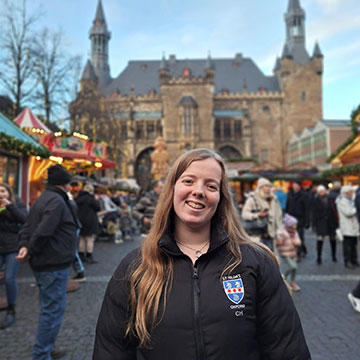
The hardest part is starting.
I think a lot of people really want to do something meaningful but get het up with what this should look like and how they do it. My advice is to just find something you're passionate about – it could be women’s rights or animal rights or this policy that you really don’t like and think should be changed – and go from there. You don't need to feel any pressure to do anything big and flashy and especially nothing big and flashy from the beginning. You can make a positive impact just by speaking to people and raising awareness.
There are also hundreds of charities out there that are desperate for volunteers. Do the research and figure out what would be meaningful for you – where does your skill set lie? What is it exactly that you want to do about the issue? Are you happy doing anything as long as it helps, or do you really want to be speaking to people on the ground? And if all else fails, there are a lot of individual influencers out there – connect with them.
What’s next for you?
Career-wise the next three years are going to be the PhD, and I have some exciting things coming up with the activism. Beyond that, I’d love to stay in academia – it’s not the most stable career out there at the moment, so maybe I'll move into something like the civil service, policy work, or do a mix of both. Liverpool has me tied down until 2029, so I have plenty of time to figure it out.
move to carousel movement controls
 Pause slideshow
move to carousel content
Pause slideshow
move to carousel content
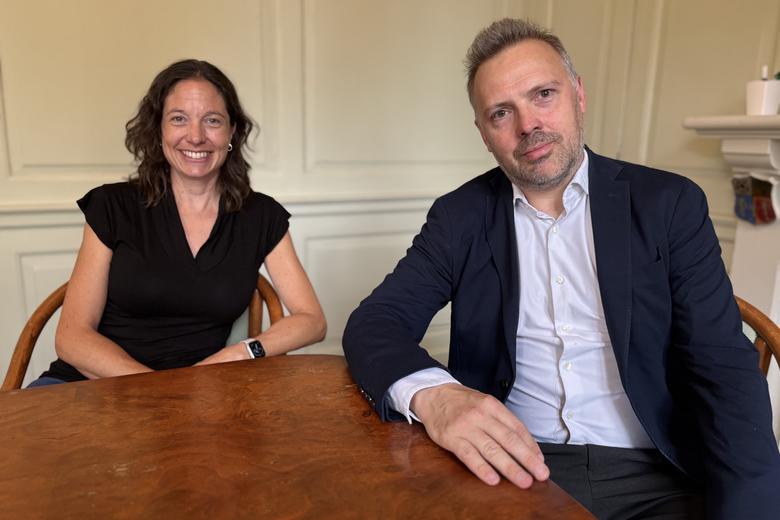
OXFORD'S NEW DEGREE
OXFORD'S NEW DEGREE
SARAH RUDEBECK
SARAH RUDEBECK

OFF THE SHELF: SEPTEMBER 2026
OFF THE SHELF: SEPTEMBER 2026
ELLA BARON
ELLA BARON
THE IMPORTANCE OF VACCINE ADVOCACY
THE IMPORTANCE OF VACCINE ADVOCACY

SILICON VALLEY CAREER TALK
SILICON VALLEY CAREER TALK

DEGREES WORTH IT AFTER ALL
DEGREES WORTH IT AFTER ALL

OFF THE SHELF: AUGUST 2026
OFF THE SHELF: AUGUST 2026

THE RISE OF BACTERIAL RESISTANCE FROM POULTRY FARMS
THE RISE OF BACTERIAL RESISTANCE FROM POULTRY FARMS
NATURAL HISTORY AT OXFORD REVAMPED
NATURAL HISTORY AT OXFORD REVAMPED

OFF THE SHELF: JULY 2026
OFF THE SHELF: JULY 2026
Pause slideshow

