

OFF THE SHELF: SEPTEMBER 2026
OFF THE SHELF: JULY 2026

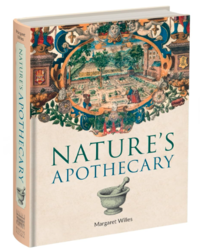
Nature’s Apothecary by Margaret Willes (Bodleian Library Publishing, July 2026)
A wonderful book for an English summer, scorching though it may be. This handsome volume, the fourth for Bodleian Library Publishing by botanical expert Margaret Willes (LMH, 1964), picks up 100 plants that in different ways have been used medicinally. The collection spans herbs, flowers, fruit and vegetables. A rich history suffuses the collection, bearing in mind that monastery gardens were typically used to cultivate plants to treat the whole community. So-called ‘herbals’ were written across the ages to distil collected knowledge, or at least consensus, the whole enterprise gradually sliding away as science and modern healthcare emerged. The illustrations are mostly from John Gerard’s Herball, first published in 1597, and part of the Bodleian's collection of treasures. In passing we note that birthwort, Aristolochia clematitis, has recently been restored within the historic grounds of Godstow Abbey by the University estates team! This rare plant can be seen growing there now; it has a strange yellow flower and is poisonous. It was used by the Benedictine nuns to induce an abortion. In this same vein, the editorial team suggest that the book is an instance of cultural and social history rather than a dedicated field guide to herbal remedies, although it has elements of this. Hardbacked with a resplendent blue keeper strand, this book would make a terrific gift.
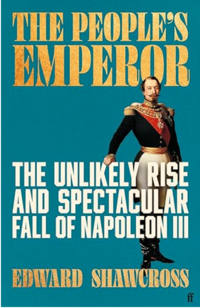
The People's Emperor: The Unlikely Rise and Spectacular Fall of Napoleon III by Edward Shawcross (Faber & Faber, August 2026)
Hot off the press, this title was inspired partly by the author’s time at New College, 2002-05, where ‘my love of history was very much fostered and I studied the period that I then went on to write about,’ he noted to us. Born into imperial splendour in 1808, Louis-Napoléon – the nephew of Napoleon Bonaparte – grew up far from power after his uncle’s defeat at Waterloo. As a young man in exile, he repeatedly plotted, unsuccessfully, to restore the Napoleonic empire. Few took him seriously. But what followed is one of the most astonishing, improbable stories in history. Aged 40, Louis-Napoléon was elected president of France in 1848. Three years later, he seized power and then became emperor. He ruled until 1870, but led the country into a disastrous war with Prussia, which cost him his throne. Napoléon III’s tale is one of self-belief, political skill and radical innovation – the first person to master mass democratic politics and populism. Yet, despite being one of the most important trailblazers of the nineteenth century, he is largely misunderstood today, if not totally forgotten. His strange rise and catastrophic fall is a story of both tragedy and farce, set during some of France’s most tumultuous decades. That’s the official description – but we’d add that other reviewers have noted the entertainment value of the book, because his detractors painted Louis-Napoléon as a grotesque farce/rascal/scoundrel and so forth. Even Queen Victoria accused him of ‘great duplicity’ after the French acquisition of Nice and Savoy. Whether his life is comparable to other world leaders around us now is for the reader to judge. But that phrase comes to mind, plus ça change, plus c'est la même chose, originally expressed in 1848.

Green Gold: The Epic True Story of Plant Hunter John Jeffrey (2nd edition, 2026) and Blough: An Anthology of Tree and Nature Poems by Gabriel Hemery
Dr Hemery (Linacre, 1996) is the Chief Executive and co-founder of the Sylva Foundation, a charity that cares for British forests. He authored The New Sylva, which was published by Bloomsbury in 2014 and remains a fabulous work of reference for all things trees. Ever lively on his website gabrielhemery.com, he has also just given free access to a terrific collection of poetry called Blough: An Anthology of Tree and Nature Poems. We note his favourite contribution to ten-word story on an environmental theme inspired, he says, by the six-word story attributed to Ernest Hemingway, ‘For sale. Baby shoes. Never worn.’ It’s called ‘The Last Supper’ (2022) and it goes like this:
Pick a Planet.
Stir gently.
Do not overheat.
Share generously.
He also reflects on the 1976 heatwave and what it does to trees, on his website. His work of history from 2019, about the Victorian plant hunter John Jeffrey, has just gone to a second edition.

Theorizing Fallism: Rhodes Must Fall and the Global Movement to Decolonize the University by A. Kayum Ahmed (Columbia University Press, May 2026)
In 2015, students at the University of Cape Town ignited a movement that would reverberate across the globe by demanding the removal of a statue of the British imperialist Cecil Rhodes. What began as a protest against a single monument became Rhodes Must Fall: a confrontation with colonial legacies at South African universities that inspired a movement at Oxford and beyond. A. Kayum Ahmed (New College, 2016) tells the powerful story of Rhodes Must Fall, tracing the emergence of a new decolonial framework, called here Fallism. Drawing on archival research and interviews with activists, he interprets Fallism as both a critique of the university – rooted in patriarchy, white supremacy, and capitalism – and a broader decolonial theory. Ahmed argues that students combined acts of defiance with deeper forms of intellectual insurgency to challenge Eurocentric curricula, linguistic hierarchies, and the silencing of Black epistemologies. In so doing, he suggests that they transformed Black pain – the source of the uprising – into a collective struggle for Black liberation. The book demonstrates how student movements create new vocabularies of resistance that transcend geographies of power. It underscores why universities remain battlegrounds in global struggles, from conflicts over statues and curricula to pro-Palestinian protests. Both a history of a movement and a work of theory, Theorizing Fallism illuminates the enduring influence of students to challenge entrenched structures of knowledge and power.
move to carousel movement controls
 Pause slideshow
move to carousel content
Pause slideshow
move to carousel content

ELLA BARON
ELLA BARON

THE IMPORTANCE OF VACCINE ADVOCACY
THE IMPORTANCE OF VACCINE ADVOCACY
SILICON VALLEY CAREER TALK
SILICON VALLEY CAREER TALK

DEGREES WORTH IT AFTER ALL
DEGREES WORTH IT AFTER ALL

OFF THE SHELF: AUGUST 2026
OFF THE SHELF: AUGUST 2026
THE RISE OF BACTERIAL RESISTANCE FROM POULTRY FARMS
THE RISE OF BACTERIAL RESISTANCE FROM POULTRY FARMS

NATURAL HISTORY AT OXFORD REVAMPED
NATURAL HISTORY AT OXFORD REVAMPED

MALACHI MCINTOSH
MALACHI MCINTOSH

EBOLA: FIRST VACCINATION
EBOLA: FIRST VACCINATION

GRAPPLING WITH THE GHOSTS OF CARIBBEAN COLONIALISM
GRAPPLING WITH THE GHOSTS OF CARIBBEAN COLONIALISM

ADAM SMITH
ADAM SMITH
Pause slideshow

