



HOLLY ELLIS
SILICON VALLEY CAREER TALK


Julian read for a law degree at Magdalen, matriculating in 1985. He’s had an amazing career, about which more in a moment. But he’s also just published Navigating Your Next: Discover the career you want and the path to get there, and that is what we discuss.
Refreshingly frank, towards the end of a wide-ranging discussion he boils down happiness as ‘meaningful relationships, meaningful work, and something to look forward to…’
He adds ruefully, ‘I paid my own price…’ a reference to quadruple bypass surgery in 2018, adding that in one role for tech giant Cisco he spent 80% of his life travelling, a recipe for impaired everything – sleep, nutrition, relationships, you name it.
The book also has some striking case studies, people who are so committed to their work that virtually every pleasure or success is deferred or buried; people who just burn out and others who sacrifice their personal lives and walk around in a daze of incomprehension as their lives collapse around them but the ambition burns on undimmed.
In one case a woman who Julian coached was massively successful yet gradually came to realise that she had been acting out successive scripts drawn up for her by others, her parents, her husbands, her children. Finally she threw it all off to write detective fiction, become single and acquire a menagerie of animals for company. It sounds extreme but such stories make the book very entertaining, as well as insightful. He is, after all, in California, not Milton Keynes.
In your twenties it’s all about ‘me, who am I?’ ‘and particularly if you are male, work is the only real answer, because any social interaction still begins, ‘what do you do then?’
Your thirties becomes ‘we’ – partners, weddings, children.
Your forties can be a bit of a reckoning, ‘should I keep climbing straight up this mountain or take a left turn at Albuquerque?’ he quips. The by then settled family and/or spousal relations might be subject to turbulence. Those highway billboards advertising divorce lawyers start to shake.
Your fifties mark an ineluctable, indelible reckoning with the fact that your youth has gone, and probably (but not inevitably) your best work. There might be a health issue. You’ll have elderly parents. Mortality can be a wellspring or it can be terrifying. Work might have become a portfolio or you might be learning a lot of new skills, changing direction while you can.
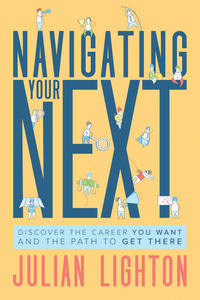
The biggest question then imposes itself, says Lighton: ‘what am I outside work?’ This can really be terrifying for people who focus like crazy on climbing that mountain, but equally a broad batted memory of higher educational achievement can lead back into the classroom of lifelong learning or to entirely new skill sets. Your fifties and beyond can be brilliant, despite inevitable blips.
Financial decisions made earlier might permit freedom, but freedom for what? It can be difficult, it can be liberating.
Everything beyond is more of the same, with a lot of looking back too but also a nurturing of a legacy even if that’s slightly self-styled: no one wants their lives to have been ‘in vain.’
Citing Oprah Winfrey, the big golden goal is to know what you want. Julian says that the most successful people he has known were resolutely focused in their goals and absolutely expert at slamming the door on distractions.
Financial security alone is never, ever, enough, and one of the big themes of the book is knowing when ‘enough is enough’. On this theme, he says, ‘Don’t defer things. If you want to do them, do them. We are polluted by ‘more’. I deeply disagree with this. We need to be more like the Spanish and Italians in that regard. Go for a good walk; it does not cost anything but is more conducive to happiness.’
‘It really is about the journey rather than the destination. Who was on the journey with you? Was it positive?’
The least happy people are driven by outside stuff and deep down don’t really know who they are. They have poor self-image but can be almost madly driven and highly successful, at least in the eyes of others. Julian says he is surrounded by that in Silicon Valley. ‘Conversely, the self-driven who do what comes out of themselves, writers, artists, they are often happy and successful, money will be an outcome more than an explicit goal.’
Gladly, we can say that the book doesn’t have a self-help matrix where you pinball yourself through a phoney matrix and voila, The Answer.
Instead, what Julian has done is to nail down an unavoidable life cycle that we are all subject to even if we deny it. Go and be happy; give and give back as you climb up.
The Careers Service offers targeted support and access to a variety of resources to Oxford University alumni.
move to carousel movement controls
 Pause slideshow
move to carousel content
Pause slideshow
move to carousel content

OXFORD'S NEW DEGREE
OXFORD'S NEW DEGREE
SARAH RUDEBECK
SARAH RUDEBECK

OFF THE SHELF: SEPTEMBER 2026
OFF THE SHELF: SEPTEMBER 2026

ELLA BARON
ELLA BARON

THE IMPORTANCE OF VACCINE ADVOCACY
THE IMPORTANCE OF VACCINE ADVOCACY

DEGREES WORTH IT AFTER ALL
DEGREES WORTH IT AFTER ALL

OFF THE SHELF: AUGUST 2026
OFF THE SHELF: AUGUST 2026

THE RISE OF BACTERIAL RESISTANCE FROM POULTRY FARMS
THE RISE OF BACTERIAL RESISTANCE FROM POULTRY FARMS

NATURAL HISTORY AT OXFORD REVAMPED
NATURAL HISTORY AT OXFORD REVAMPED

OFF THE SHELF: JULY 2026
OFF THE SHELF: JULY 2026

MALACHI MCINTOSH
MALACHI MCINTOSH
Pause slideshow

