


SARAH RUDEBECK
TOM MCCARTER
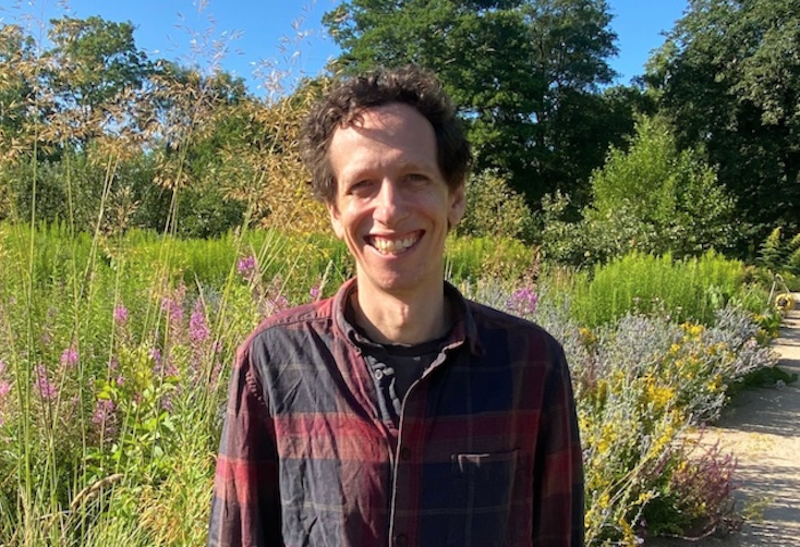

Taking time out of an incredibly busy schedule, new Curator and Head of Horticulture at Oxford’s Botanic Garden Tom McCarter hit the ground running on 1 July and has agreed to share a few working notes with QUAD, six weeks in.
The portrait of him shows the most striking expanse of Solidago canadensis (goldenrod), in an area of the Botanic Garden called the Merton Borders.
‘The goldenrod is looking amazing right now…’ he offers – a solid reason to visit the Botanic Garden in August – but it is a dominant plant that is out-competing its neighbours. Goldenrod and common reeds washed in by flooding last winter are forcing a rethink of the area.
The broader balancing act between an area that experiences floods in a wet winter followed by very dry spring and heat waves in June – it’s all part of the purpose of the Botanic Garden which is planning for climate resilience and adaptation. A nearby area of the garden tells the story of heritage grains, alongside which there are really two magnificent orchards currently groaning with nearly perfect apples (shown right).
This is before we consider the immensely popular herbaceous border, the collection of glasshouses full of exotic plants from different parts of the world, and thematic approaches such as a literary garden that includes Lyra and Will’s bench and the ‘Daemon’ sculpture, after characters in The Amber Spyglass by renowned, Oxford-based writer Sir Philip Pullman. The Botanic Garden even boasts a Gin Border and a Water Garden right down at the bottom, where Christ Church Meadow Walk converges with the River Cherwell.

Noting that his first love is horticulture, which refers to the art or practice of garden cultivation and management, Tom obtained along the way a London University MSc in plant taxonomy.
‘A garden such as Kew, and the Oxford Botanic Garden including Harcourt Arboretum really has three central functions,’ he says. ‘These are growing plants that support science, research conservation, education and public engagement.’
Many of the existing projects at Oxford Botanic Garden that Tom has inherited demonstrate this – for example the garden showcases a Heritage Grains collection including a broad variety of grains such as einkorn, wheat, rye and barley. Bere barley is the oldest cereal known to have been continuously grown in Britain.
These grains were just harvested at the height of the current summer, with the garden team joined by an archaeobotanist John Letts, plus research assistants from the Heritage Harvest Company, which is based locally but has elicited broader interest.

Part of the aim of such projects is to nurture and promulgate these half-forgotten species with their higher genetic diversity; another aim is no-till agriculture using a clover understory; and yet another is educating the public about agriculture and the fact that modern methods since the mid-20th century are not sustainable ecologically, relying too heavily on chemical and other fossil fuel-derived inputs.
Looking ahead to 2026, Tom says that behind the scenes there will be a re-building of new nursery homes that have outworn their original lifespan and need replacing. He adds that some of the APG beds, large beds that tell the story of flowering plant evolution, will have new plants added with adjustments made for resilience.
He notes with enthusiasm the fact that the garden has cultivated strong links with the local community and nature restoration communities in Oxfordshire, while at the same time sustaining research ties with the Philippines and Japan, to mention just two links.

Tom’s previous role was at the Natural History Museum in London, where he was part of the transformational Urban Nature Project which changes how you approach the museum from the Underground station, with a brilliant, fossil-encrusted garden right out front presided over by an enormous dinosaur skeleton.
Originally from New Zealand, his first role in the UK was as a Diploma student at RBG, Kew before later taking on roles in the tropical nursery at Kew, Chelsea Physic Garden, later returning to Kew and building up a much-admired Community Horticultural Programme that included all sorts of classes and hands-on gardening for the public.
Back at Oxford, he says that two new apprentices will begin in September for two years, while the Botanic Garden provides valuable work experience and welcomes many volunteers over the course of a normal year, extending of course to Oxford alumni, many of whom are ‘Friends’ of the Botanic Garden.
The apples will be nibbled by visitors and harvested for the local food banks and charities, he says.
‘We have to behave in the here and now but plan for fifty, a hundred, three hundred years ahead.’ That means not only factoring in climate change and adaptation to the sort of flood/drought extremes that have been experienced already in 2025, but shaping research towards the British adaptation of plants that can thrive in such conditions.
It's an exciting time for the Botanic Garden and a full schedule for Tom.
move to carousel movement controls
 Pause slideshow
move to carousel content
Pause slideshow
move to carousel content

OFF THE SHELF: SEPTEMBER 2026
OFF THE SHELF: SEPTEMBER 2026

ELLA BARON
ELLA BARON

THE IMPORTANCE OF VACCINE ADVOCACY
THE IMPORTANCE OF VACCINE ADVOCACY

SILICON VALLEY CAREER TALK
SILICON VALLEY CAREER TALK

DEGREES WORTH IT AFTER ALL
DEGREES WORTH IT AFTER ALL

OFF THE SHELF: AUGUST 2026
OFF THE SHELF: AUGUST 2026
THE RISE OF BACTERIAL RESISTANCE FROM POULTRY FARMS
THE RISE OF BACTERIAL RESISTANCE FROM POULTRY FARMS
NATURAL HISTORY AT OXFORD REVAMPED
NATURAL HISTORY AT OXFORD REVAMPED

OFF THE SHELF: JULY 2026
OFF THE SHELF: JULY 2026

MALACHI MCINTOSH
MALACHI MCINTOSH
EBOLA: FIRST VACCINATION
EBOLA: FIRST VACCINATION
Pause slideshow

