



SARAH RUDEBECK
OFF THE SHELF: AUGUST 2025

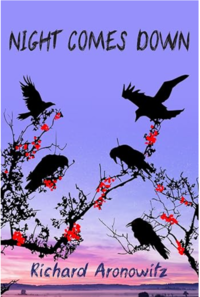
Night Comes Down by Richard Aronowitz (Guernica World Editions, 1 September 2025)
For his fourth novel the author (Kellogg, 2017) has turned his attention to the unblemished rural idyll of Much Purlock in Herefordshire in the early years of the reign of Queen Victoria, to recreate the coming of the railway and the seismic shock that it engendered, in every sense including the literal percussion cap of deafening explosions as ancient rock formations were blown to smithereens allowing crews of Irish navvies to rapidly lay track straight through country that had lain untouched for thousands of years.
He focuses the drama around a budding romance between an unlikely couple, Grace Matthews, the daughter of a Cambridge-educated physician, and Sean McClennan, an Irish farm hand from County Sligo turned railway worker, as burly as can be. The raw attraction drives the narrative but also draws attention to the contradictory impulses of modernity. Jumping ahead on the timeline, the author divulges early on that Grace, who is the voice in the narrative, ends up in a lunatic asylum, so the reader knows that something must go dreadfully wrong. There are other bad omens such as rooks falling dead with cankered beaks, and a railway foreman Mr Sansom getting killed by an accident – perhaps a Biblical reference to superhuman strength undone.
Taking the first-person view of Grace, Aronowitz details how her mother had died of breast cancer that modern medicine could not cure, adding a grief narrative. Her father had made her lady of the house at the age of ten, dismissing the cook, resulting in a smouldering resentment that explodes in the form of her wandering the hedgerows and trying to administer secret potions to punish him. There are comedy moments as the mushroom powder takes effect:
‘He looked at me with a glazed expression, a sheen of sweat on his face. "Beelzebub the clover-hoofed one is calling me," he said, and collapsed from his chair onto the floor.’
But the appeal to pre-modern medicine, if it can be referred to thus, turns out to be as noxious as the smoke emitted by the inaugural train cranking up the valley, the focal point and ultimate denouement where a great scene ensues and Grace is arrested and sent off to the asylum by her own father.
Much earlier in the narrative, Grace states: ‘What is magic if not the reaching for something that is beyond our grasp?’
It is the witches’ cauldron mirror being held up to the scientific Enlightenment that is driving the steam age, and the world of medical discovery where nothing is admitted beyond science.
Both worldviews are shown wanting and neither a match for Grace’s sparkly attraction to Sean, furtively glimpsed through oak leaves while he desecrates the fields with a pick axe; she, aware of her contradictory position, is also driven by rebellion against Victorian repression of women’s freedom.
A fine novel intended to lap at our own shores of environmental angst, ‘Those dead rooks were us.’
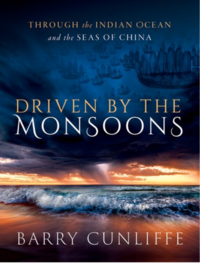
Driven by the Monsoons by Barry Cunliffe (Oxford University Press, 28 August 2025)
The Silk Road – subject of one of Barry’s previous majestic volumes – may be one origin of globalisation, but the Indian Ocean is another. Here, Sir Barry Cunliffe, Emeritus Professor of European Archaeology at Oxford, examines the beginning of maritime trade using the evidence of archaeology and the tales of great travellers such as Marco Polo, Ibn Battuta, and the Chinese Admiral, Zheng He. This story complements that of the land routes, showing how humans have been driven across thousands of years to create and maintain networks whatever the difficulties.
Driven by the Monsoons illuminates maritime connections between the Indian Ocean and its surrounding water routes: the Arabian Gulf and the Red and China Seas. It begins with the movement of humans into Southeast Asia and ends about 1600 CE when European companies emerge to takeover. It is tale of exotic goods, material needs, adventure and desire.
While conditions at sea and the abilities of the maritime communities provided a degree of stability, the direction and intensity of trade and the types of commodities on the move was determined by the fortunes and aspirations of distant empires, those of China in the east and Southwest Asia and the Mediterranean in the west. This ever-changing pressure provided the dynamic situation in which society and economies in East Africa, India and Southeast Asia flourished. Driven by the Monsoons explores the birth of the modern, connected world.

Economic Warfare in the 21st Century: Are the UK, NATO, and EU fit to Fight? (Edited by Greg Kennedy, Springer)
Maria de Goeij Reid (a senior research fellow at Oxford’s Changing Character of War Centre) has contributed a chapter to Economic Warfare in the 21st Century, published in August.
Maria’s chapter is on ‘British economic statecraft from the perspective of complexity.’
This volume critically examines whether the United Kingdom, NATO and the EU are equipped to engage in both defensive and offensive economic warfare. In an era where economic leverage is increasingly used as a tool of statecraft, nations worldwide are struggling with the complexities of economic warfare. The book discusses contested terminology and concepts, often blurred with geoeconomics, economic statecraft and weaponised interdependence.
Through a thorough analysis of organisational structures, doctrines and strategic cultures, the book explores the legitimacy and implications of using economic means to influence state behaviour. As global actors ramp up their economic warfare capabilities, it questions whether such strategies are a necessary evolution or a disruptive force to international norms.
move to carousel movement controls
 Pause slideshow
move to carousel content
Pause slideshow
move to carousel content
OFF THE SHELF: SEPTEMBER 2026
OFF THE SHELF: SEPTEMBER 2026

ELLA BARON
ELLA BARON

THE IMPORTANCE OF VACCINE ADVOCACY
THE IMPORTANCE OF VACCINE ADVOCACY
SILICON VALLEY CAREER TALK
SILICON VALLEY CAREER TALK

DEGREES WORTH IT AFTER ALL
DEGREES WORTH IT AFTER ALL

OFF THE SHELF: AUGUST 2026
OFF THE SHELF: AUGUST 2026
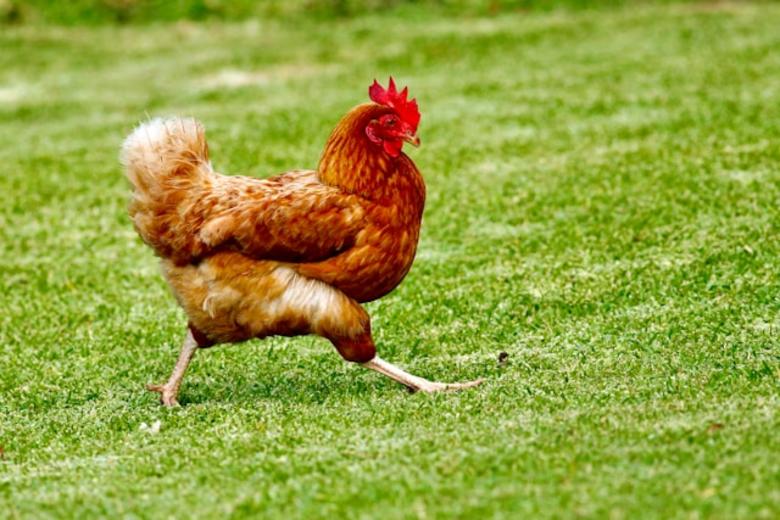
THE RISE OF BACTERIAL RESISTANCE FROM POULTRY FARMS
THE RISE OF BACTERIAL RESISTANCE FROM POULTRY FARMS

NATURAL HISTORY AT OXFORD REVAMPED
NATURAL HISTORY AT OXFORD REVAMPED

OFF THE SHELF: JULY 2026
OFF THE SHELF: JULY 2026

MALACHI MCINTOSH
MALACHI MCINTOSH

EBOLA: FIRST VACCINATION
EBOLA: FIRST VACCINATION
Pause slideshow

