

EVERYDAY BEETHOVEN
EVERYDAY BEETHOVEN
An inaugural lecture celebrates the ‘everyday’ meaning of music
Published: 26 February 2026
Author: Richard Lofthouse
Share this article
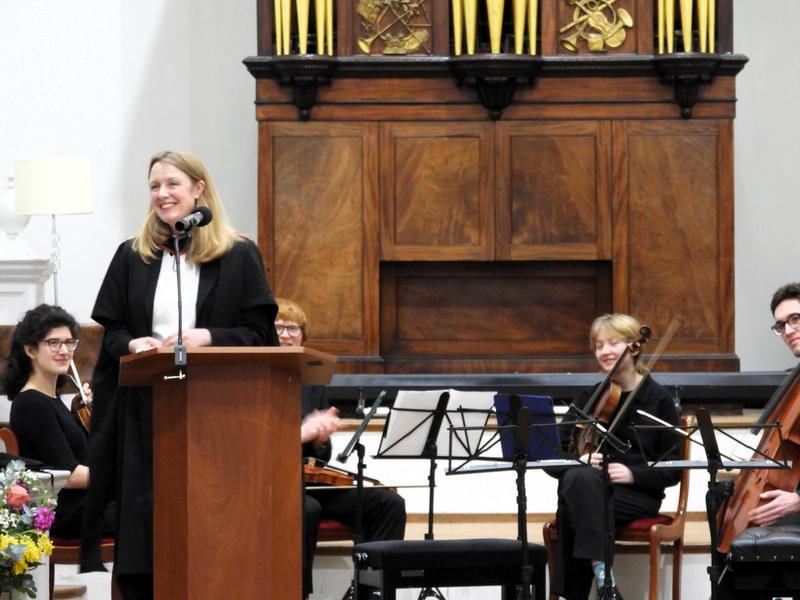
Professor Laura Tunbridge took up the Heather Chair of Music, the Faculty of Music’s only statutory chair, in October 2025. She gave her inaugural lecture at the Holywell Music Rooms on 19 February, entitled ‘Everyday Beethoven’.
In her lecture she spoke broadly about the desirability of ‘anti-monumentalism’, or the desirability of making Beethoven more accessible, more ‘everyday’. Often lauded as one of the greatest composers of Western classical music, perhaps the greatest, historically this has led to Beethoven’s music being caught up in specialist knowledge, making it accessible only to connoisseurs.
Born in Bonn and baptised on 17 December 1770, Beethoven moved to Vienna in 1792, where he lived for the rest of his life, dying there on 26 March 1827. Professor Tunbridge drew on Tia DeNora’s argument that music is ‘a constitutive feature of human agency’ to show how Beethoven’s works could sometimes provide a ‘respite from worldly concerns,’ perhaps a way to relax, and often a way to feel happiness.
A snatch of Beethoven’s ‘Für Elise’ is apparently broadcast by Taiwanese rubbish trucks to announce their presence, which made the audience laugh: an extreme version of ‘everyday’.
Professor Tunbridge also spoke about Beethoven as a site of resistance, as focus for courage, bearing in mind that he began to lose his hearing in his 30s but continued to compose.
The audience was treated to renderings of ‘off the beaten track’ elements of his music that enlightened what we know about his close but turbulent friendship with cellist Nikolaus Zmeskall (1759–1833), in particular the 1810 String Quartet in F Minor (Op. 95).
From such fragments the audience gleaned elements of the human Beethoven as opposed to the one valorised by boffins and experts, drawing to some extent on Professor Tunbridge’s acclaimed 2020 book, Beethoven: A Life in Nine Pieces.
Professor Tunbridge confirmed that while Beethoven remains at the towering height of Western classical music, there is now a significant and sustained academic effort to bring the giants back down to earth, in a way that celebrates their real achievements and unlocks their oeuvres.
The approach was honoured in the room, which despite being crammed and a formal occasion with attendance by begowned members of the University, offered student performances of examples from Beethoven rather than formal, elite performances of entire pieces.
Previously Henfrey Fellow in Music at St Catherine’s College, Professor Tunbridge has now moved to Wadham College, where the Heather Chair has long been associated with a professorial fellowship.
The Heather Chair celebrates its 400th anniversary in 2026, its first post-holder Richard Nicholson in 1626. The foundation is named after William Heather, who wanted to provide training in both practical and speculative branches of music. Professor Tunbridge is the first woman elected to the chair. In October 2025 she also succeeded Professor Elizabeth Eva Leach as Faculty Board Chair/Head of Department, a post she will hold for three years.
If you visit Oxford and find yourself in New Marston, many of the streets were named after past Heather Professors: [Richard] Nicholson Road (1626); [Richard] Goodson Walk (1682); [William] Hayes Close (1741); [William] Crotch Crescent (1797); [Fredewrick] Ouseley Close (1855); [John] Stainer Place (1889), [Hubert] Parry Close (1900); Hugh Allen Crescent (1918) and [Jack] Westrup Close (1947).
Faculty of Music, University of Oxford
Schwarzman Centre for the Humanities, Radcliffe Observatory Quarter, Woodstock Road, Oxford OX2 6GG
Student performers at the lecture were: Emmanuel Sowicz, guitar; Ella McLoughlin, violin; James Murray, violin; Isobel Neary-Adams, viola; and Rudyard Cook, cello.
Image credit: Faculty of Music, University of Oxford
While degrees in music have been granted by the University since the early 1500s, the Faculty of Music was only established in 1944. Originally housed in buildings next to the Holywell Music Room, the faculty moved to premises on St Aldate’s in 1981 and then in October 2025 into the newly built Schwarzman Centre for the Humanities in the Radcliffe Observatory Quarter, nestled between Woodstock Road and Walton Street.
Alumni are welcome to attend a weekly recital, held at 1.15pm in the Schwarzman Centre for the Humanities recital hall. Each concert lasts around 40 minutes and offers a variety of repertoire from multiple performers. The series takes place on Friday afternoons throughout term. For all forthcoming events, many of them free, visit the events page.