60 YEARS OF ST CROSS

St Cross College

60 YEARS OF ST CROSS

One of the University’s pioneering graduate colleges is celebrating a milestone birthday in 202526 

Published: 23/12/2025


Share this article

It’s funny how time slides by in Oxfordland. Still well within living memory, the University came to a tricky pass in the post-war years where it was bursting at the seams with an expansive new generation of academics and graduate students who had no college affiliation.  

The situation was untenable as it stood. The unaffiliated academics even came to be known as ‘non-dons’.  

Two of the campaigning individuals were W E Kits van Heyningen and Marshall ‘Mac’ Spencer, who in 1961 helped to establish the Oxford Collegiate Society.  

The society’s role was in helping to coordinate new colleges for graduate students and the ‘non-dons’. 

Out of this came enterprising individuals and generous benefactors, and St Cross College was founded in 1965, initially on a site adjacent to Holy Cross Church on St Cross Road (near to today’s St Catherine’s, founded 1962). 

That original site was acquired from Merton and comprised a vicarage and some additional school buildings, with a wooden structure purposely built, affectionately known to all as ‘the hut’. 

The first governing body meeting was hosted by Merton College on 5 October 1965. Subsequently, creamy chicken and chestnut mousse were consumed at a founding dinner on 9 December 1965, hosted by Trinity College.

St Cross College was born, but the past six decades have seen enormous, transformational changes, demonstrating beyond doubt what magic can be achieved by focused individuals and generous philanthropy.

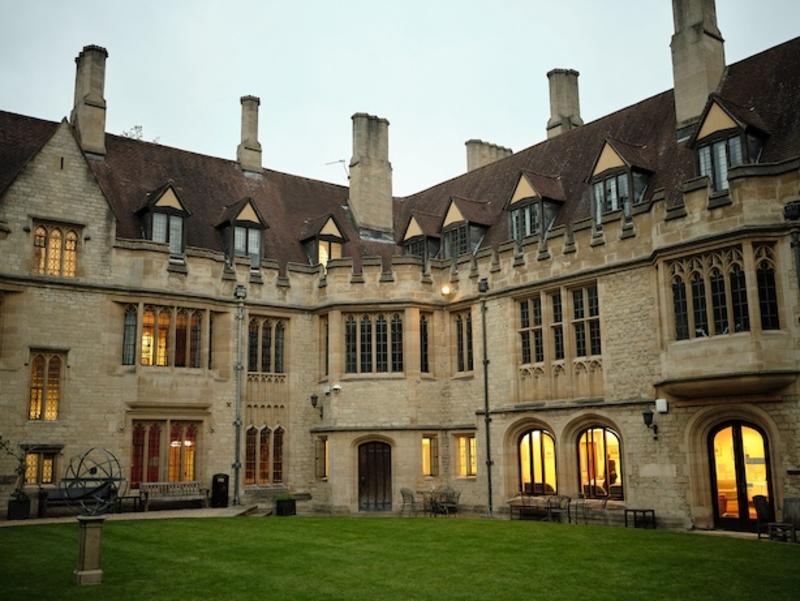
The really big change came in 1981 when the college moved to its central Oxford site just off St Giles, a location it shares with Pusey House, thanks to a substantial benefaction by Richard Blackwell, of bookselling fame.  

Large changes were made to create the buildings of today; the cloisters for instance enclosed to make the dining hall. A south wing followed in 1993, and a west wing in 2017, while the college was granted its coat of arms in 2000. 

What hasn’t changed is the ethos of the college, which from the first day was interdisciplinary, inclusive and international, vibing with the 60s but also moving to a model where the research-oriented students were typically treated as colleagues by the fellows. 

The international flavour of the college remains its living and breathing reality in 2025, St Cross having hosted students from more than 100 countries, studying across virtually every discipline offered at Oxford. With over 650 students, it is a thriving hub for postgraduate study.  

St Cross College is a vibrant example of a broader transformation of the University towards research intensity alongside student excellence. The first twentieth-century college accepting only graduate students was Nuffield (1937). Then came St Antony’s (1950); Linacre (1962); St Cross (1965); Wolfson (1966); Kellogg (1990) and Reuben (2019). 

St Cross is celebrating its 60th anniversary throughout this academic year (until the end of September 2026). The celebrations include a fundraising campaign, historical exhibitions, and special events for alumni, students, fellows and friends. Wolfson will follow suit with its own celebration programme in 2026. 

St Cross College – more information on the 60th anniversary of the college