



OFF THE SHELF: SEPTEMBER 2026
JOIN A HEDGEROW SEED WORKSHOP

A group of Oxford alumni and friends of the Botanic Garden met by a hedgerow at the University’s Harcourt Arboretum in October, for a hands-on seed harvesting workshop, so QUAD went along to join in and report back.
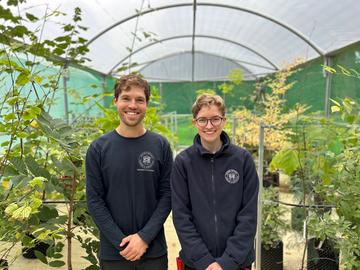
Lewis Barrett, Senior Botanical Propagator, and Emma Gray, Junior Botanical Propagator (right), accompanied us as we strolled down several hundred metres of prolific native English hedge. The first, overwhelming impression was what a bounteous harvest we have in 2025.
Lewis explains, ‘It’s basically a mast year for everything…’, the term referring to vintage years in which mature trees like oaks put out extra-large quantities of acorns.
The unusually dry spring and light winds allowed strong pollination and excellent fruiting.
We need no proof because it is staring us in the face. Abundant, fat sloes on the spiky blackthorn (Prunus spinosa); cascading sprays of bright red berries on the ubiquitous hawthorn (Crataegus monogyna); enormous dog rose hips (Rosa canina – below left) and thick clusters of guelder rose berries (Viburnum opulus).
We begin to collect, daintily picking the berries into very neat, branded cotton drawstring bags provided for the course (classily Oxford!), and just a few minutes later we seem to be creaking with fruit.
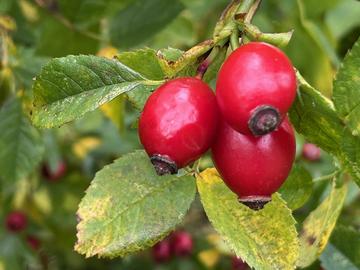
The question was asked, had we missed anything and which species are not in this hedge but common to many? A spirited discussion ensued.
We had missed the persian buckthorn (Rhamnus cathartica), a major source of yellow and red dyes in the medieval period. In this instance the berries were small and dark.
Meanwhile species that are widespread in lowland England but not present in this particular hedge include crab apple (Malus sylvestris); pyracantha (Pyracantha coccinea); spindle (Euonymus europaeus) and holly (Ilex aquifolium). To say nothing of favourite trees such as the wild service tree (Sorbus torminalis) and so many more, sometimes referred to as ‘standards’ – but now we’re straying into woodland species.
The poet John Keats might have written his 1819 poem ‘To Autumn’ for 2025, given the extent to which ‘season of mists and mellow fruitfulness’ describes the spectacularly fruit-laden harvest we are in the midst of.
And the great thing about seed collecting is that literally anyone can do it including children, with basic precautions around thorns and permissions. The local park or patch of common ground is just as inviting as field boundaries and farms, and there are literally millions of acorns and conkers to be scooped up for future forests this year, alongside the hedgerow seeds we were targeting.
We troop back to Harcourt Arboretum’s latest addition, a cluster of four greenhouses that sequentially furnish a large-scale propagator, the Plant Conservation Hub, to extract the seeds from the pulpy fruits, check for ‘viability’, and then look to ‘overcome dormancy’ by setting them off on a programme of stratification.
If anyone reading this is an accomplished gardener, as we know numerous alumni are, none of these terms will be foreign. But an explanation was in order for those of us on the workshop.
Emma sliced an acorn in two and it was white across the middle – a sign of health and thus ‘viability’ and an indication that the other acorns around it will for the most part be fine.
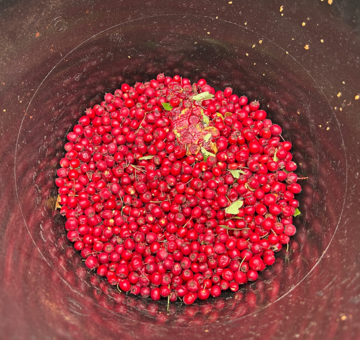
Then we focused on hawthorn berries (right) as perhaps the most ubiquitous English hedgerow classic, tolerant of poor soil and erratic weather, and a wildlife haven with claimed health-giving properties around hypertension and other human maladies.
In nature, Lewis explained, birds eat the berries and excrete the seeds, and then after some months they may germinate and take hold. Otherwise, the fruity pulp actually has growth inhibitors built into it and will greatly delay any germination process.
All our hawthorn berries went into a big bucket and we began to mash them up with a piece of timber, then flooding the mixture with fresh water and draining away the pulp. Repeat the process a few times until the pulp has gone, while the heavier seeds sink to the bottom. We are left with the seeds which can be dried on a towel and then set up in a vermiculite and compost mixture, or with sand, moistened and bagged up for stratification.
Stratification is to improve germination rates and get there quicker than if the seeds were simply scattered, although not all seeds need it – acorns in particular germinate as soon as they can so you can simply plant them and hope for the best.
Stratification source notes are shared below, but will typically involve a stretch of weeks at room temperature and a stretch of time in the cold, usually in a fridge or outdoors. For hawthorn it’s 4–8 weeks warm, followed by 12–16 weeks cold – although we note here that different authorities rarely prescribe exactly the same stratification formula and you’re meant to keep an eye on it. If they germinate then plant them!
The time raced by and suddenly half a day had gone and we had a bench of drying seeds. But there was time to briefly discuss the wider aims of the Plant Conservation Hub. Emma and Lewis say that many of the magnificent trees at the Harcourt Arboretum need a succession plan. Many of them are already present in sapling form in pots. Each of four greenhouses progress from warmer glass to cooler plastic-on-frame construction, with variable ventilation and shading.
There is an important conservation purpose for the facility, as well as planned resilience in the face of climate change.
Seed propagation and conservation at the arboretum are vital to safeguarding plant diversity and ensuring the long-term survival of rare and threatened species. By collecting, propagating and cultivating seed from wild and cultivated sources, the arboretum plays a key role in preserving genetic diversity and supporting ex situ conservation. These efforts not only maintain living collections that serve as a valuable resource for education, research and restoration, but also strengthen global conservation networks by providing material for reintroduction and collaborative study. Through careful documentation and propagation, the arboretum helps secure the future of vulnerable tree populations for generations to come.
Alongside this a brilliant chance to populate a new native English hedgerow the old-fashioned way – from seed, and the immediate backdrop of the workshop. Harcourt Arboretum has a 350-metre long section of boundary where a new native English hedge will be planted from scratch, so at six whips per metre that’s over 2,000 plants. Not the impossible task it sounds when in 2025 there are almost illimitable quantities of seed all around us.
move to carousel movement controls
 Pause slideshow
move to carousel content
Pause slideshow
move to carousel content
ELLA BARON
ELLA BARON

THE IMPORTANCE OF VACCINE ADVOCACY
THE IMPORTANCE OF VACCINE ADVOCACY

SILICON VALLEY CAREER TALK
SILICON VALLEY CAREER TALK

DEGREES WORTH IT AFTER ALL
DEGREES WORTH IT AFTER ALL

OFF THE SHELF: AUGUST 2026
OFF THE SHELF: AUGUST 2026
THE RISE OF BACTERIAL RESISTANCE FROM POULTRY FARMS
THE RISE OF BACTERIAL RESISTANCE FROM POULTRY FARMS

NATURAL HISTORY AT OXFORD REVAMPED
NATURAL HISTORY AT OXFORD REVAMPED

OFF THE SHELF: JULY 2026
OFF THE SHELF: JULY 2026

MALACHI MCINTOSH
MALACHI MCINTOSH
EBOLA: FIRST VACCINATION
EBOLA: FIRST VACCINATION

GRAPPLING WITH THE GHOSTS OF CARIBBEAN COLONIALISM
GRAPPLING WITH THE GHOSTS OF CARIBBEAN COLONIALISM
Pause slideshow

