


HOLLY ELLIS
OXFORD IN JAPAN, 120th ANNIVERSARY
Cambridge got there first with an alumni society that Oxford joined collaboratively in 1905, meaning that 2025 marks the 120th anniversary of the combined entity.
The society celebrated the landmark anniversary with a celebratory gala dinner on 22 March at the Imperial Hotel, a black-tie affair attended by over 160 members, including two members of the imperial family representing their respective universities (Princess Akiko of Mikasa (Merton, Oxford 2004) and Princess Takamado (Girton, Cambridge, 1978)).
Heading the Cambridge & Oxford Society, Tokyo, is Naoko Miyazaki (née Taida) (St Anne’s, 1992).
Although she credits Oxford as a period that defined many aspects of her outlook in life and her subsequent career as a museum curator, lecturer and a translator, it remained a closed phase in her life, until she discovered the C&O Society ten years ago. ‘So part of my purpose is to spread the word so as to make sure other alumni find us a bit sooner than I did,’ says Naoko, ‘For many years I missed Oxford but felt a little distant as I navigated my life, moving to different countries, away from my friends. So it was the best feeling when I found the C&O – it was like coming home. My mission now is to carry the baton from my predecessors in maintaining and nurturing this historic organisation, providing time and space for the members to come together, relax and be inspired.’
The C&O Society has a very vigorous life with ten social events, including a flagship early summer party, typically held at terrific, often exclusive venues and invariably commanding long waiting lists, and two golfing events a year. The society boasts over 350 members and the majority of the monthly social events are for 60–80 or more people. The society has seen a surge in membership and attendance since the pandemic and the popularity of recent events has delighted and flabbergasted the committee (a dedicated group of volunteers who run the society) in equal measure.

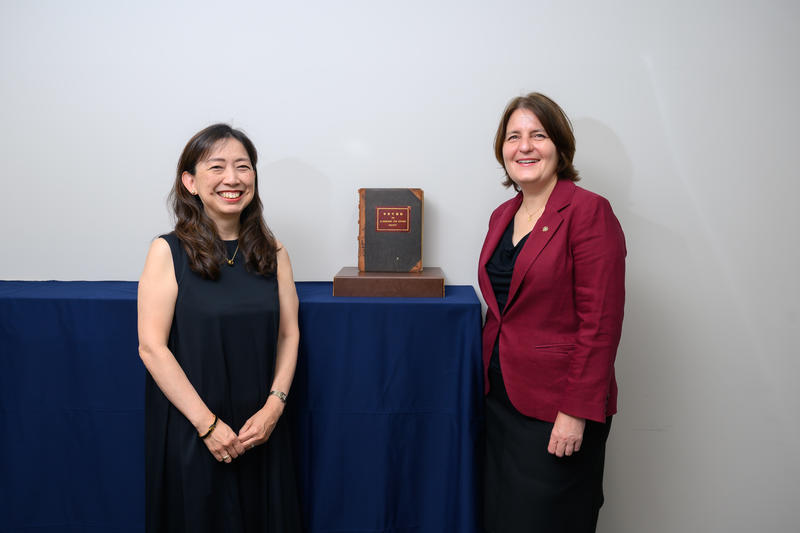
Naoko shows QUAD a minute book (right), a second volume dated 10 May 1921, which begins by referencing the 37th annual meeting, the complication being that there appear to have been two such meetings in different years, so the 1905 dating is actually drawn from other sources. In a 1995 essay commemorating the 90th anniversary of the Cambridge & Oxford Society, the late Mr Giro Koike (Magdalene College, Cambridge, 1931-34), whose father-in-law was a senior member, places the founding of the Cambridge Society in 1903 and the founding of the Cambridge & Oxford Society in 1905.
The first minute book is lost – perhaps, says Naoko, to the Great Kanto Earthquake of 1 September 1923, which decimated the city of Tokyo and environs through its immense magnitude and associated fires.
The C&O Society was then dissolved in 1942 in the teeth of the Second World War, starting up again in 1950, but informal bonds of strong friendship were undoubtedly maintained during those eight dormant years, says Naoko, ‘On reading the minutes before WWII, you do get the sense that the members were determined not to let world events erode personal friendships that they cherished within the society even as the situation was getting increasingly dire. For instance, soon after Japan entered the war, Prince Chichibu (Magdalen, 1926), who was a regular attendee, together with his wife Princess Chichibu secretly sent a personal message accompanied with a lump of mutton from their farm to the British ambassador Robert Craigie who had been put under house arrest, according to Princess Chichibu’s memoir (1991). Prince Chichibu was a younger brother of Emperor Hirohito and an elite member of the imperial army, so he was taking a considerable risk.’
The first woman was admitted on 13 February 1951, a certain Eileen L Fraser (St Anne’s, 1938).
The C&O Society has consistently been at the centre of Anglo-Japanese relations, the president typically being the British ambassador to Tokyo, currently Julia Longbottom CMG (Jesus, Cambridge, 1982). Naoko notes that the society has customarily invited each ambassador to serve as president and this request has always been graciously accepted even on the one occasion before the war when the ambassador had been to neither university. Reflecting the changing nature of the two universities, today the society is very cosmopolitan and diverse, with numerous nationalities and different age ranges represented.
But it retains a core British and Japanese identity, and to become a member there is a straightforward bar – you have to have nine terms of residency at Oxford or Cambridge under your belt, or a degree (which includes master's degrees) or diploma from either university.
There were early cultural distinctions to the Japanese side of the equation, noted by A B Mitford in his 1906 book, The Garter Mission to Japan:
Noting that to the Japanese education is ‘something as sacred as religion itself’ Mitford offered:
‘A gathering of the Cambridge Society of Japan is, therefore, an assembly of gentlemen highly cultivated, not only in the learning of their own country, but also in those branches of study which are taught in our universities, and the conversation is perhaps more varied in such a group of men than it is in any similar body in the world. Questions of science, questions of letters, of history, of political economy, of philology, are discussed with just that tinge of oriental imagery which gives a spark of the divine fire to whatever it touches, stifling pedantry and brightening the narrow dullness of the common room.’
Naoko responds, ‘These comments still ring true in the sense that our conversations can cover highly intellectual topics, but we also take pleasure in light banter and the silly. I think the club is so successful because the members are here to enjoy each other’s company without any agenda, which is not unlike our student days when we talked about anything and everything – and it was all right to disagree.’
The society has also hosted visitors from the two universities such as chancellors, vice-chancellors, and heads of house, often in collaboration with the University of Oxford Japan Office based in Tokyo. Receptions have also been held for visiting boat crews, rugby teams and college choirs, specifically those of King's, St John's, Girton and St Catharine’s Colleges, Cambridge, and of New College, Oxford. On 16 May 1983, the president gave a lunch party to honour His Imperial Highness Prince Naruhito, now the emperor (Merton, 1983), who was to go up to Oxford the following Michaelmas term. After his return to Japan and before becoming the emperor, His Majesty returned to the society several times, sometimes with Her Majesty The Empress Masako (Balliol, 1988).
Naoko concludes ‘Our members span from new graduates in their twenties to nonagenarians, inevitably with different background and experience, but there is a real sense of camaraderie and mutual respect which is inspirational. People may come to reminisce or to network, but I think they go home with so much more. I feel that this has been the key to our longevity.’
The Cambridge & Oxford Society also has a Kansai chapter, which was inaugurated in 1938 and re-inaugurated at the Century Club in Osaka on 6 November 1998.
move to carousel movement controls
 Pause slideshow
move to carousel content
Pause slideshow
move to carousel content

OXFORD'S NEW DEGREE
OXFORD'S NEW DEGREE

SARAH RUDEBECK
SARAH RUDEBECK

OFF THE SHELF: SEPTEMBER 2026
OFF THE SHELF: SEPTEMBER 2026

ELLA BARON
ELLA BARON

THE IMPORTANCE OF VACCINE ADVOCACY
THE IMPORTANCE OF VACCINE ADVOCACY

SILICON VALLEY CAREER TALK
SILICON VALLEY CAREER TALK

DEGREES WORTH IT AFTER ALL
DEGREES WORTH IT AFTER ALL

OFF THE SHELF: AUGUST 2026
OFF THE SHELF: AUGUST 2026

THE RISE OF BACTERIAL RESISTANCE FROM POULTRY FARMS
THE RISE OF BACTERIAL RESISTANCE FROM POULTRY FARMS
NATURAL HISTORY AT OXFORD REVAMPED
NATURAL HISTORY AT OXFORD REVAMPED

OFF THE SHELF: JULY 2026
OFF THE SHELF: JULY 2026
Pause slideshow

