

OFF THE SHELF: SEPTEMBER 2026
REVISITING JOHN WILKES

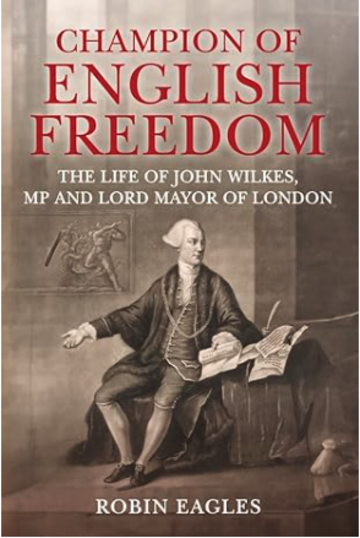
Robin Eagles (Magdalen, 1989) didn’t set out to write a biography of John Wilkes. The commission, as he tells it, began with a speculative email from Amberley Publishing. At first glance, it looked like a scam. ‘I assumed it must be some sort of phishing attempt,’ he jokes, recalling the moment he received the proposal. But it was real – and the idea quickly grew legs. Among the proposals Eagles floated, one stood out: a new life of John Wilkes (1725-97 – born on 17 October, exactly 300 years ago), the famous – and infamous – 18th-century radical, rake and populist.
Eagles had already spent years immersed in the 18th century working for the History of Parliament, where he is now editor of the 18th-century Lords project. That long-standing initiative, a national scholarly treasure narrating the careers of MPs and peers that traces its own beginning to the 1930s, gave him the archival familiarity and professional infrastructure to tackle Wilkes. He says he wanted to bring Wilkes back into view for a more general audience, but through a scholarly re-study of the available evidence.
The resulting volume, Champion of English Freedom: The Life of John Wilkes, MP and Lord Mayor of London, was launched in June 2024 to coincide with the 250th anniversary of Wilkes becoming Lord Mayor of London, but it is slated for more attention in October this year, on account of the 300th anniversary of his birth.
Eagles says that he was worried about the project initially, because Wilkes had already been written about so much. Yet one of the underlying causes of so much attention is that he was so elusive, even to himself, suggests Eagles.
‘I really wanted to bring his character forward in a way that sometimes seems to be lacking. Even in a treatment like Arthur Cash's, where he's read every single paper, sometimes you actually lose Wilkes a bit. There are these lovely details, which just tickled me, such as his gardening passions, you know, chasing down strawberry plants in nurseries, and his devoted relationship to his daughter Polly, often neglected.’
From long engagement with the 18th Century, Eagles was also aware of needing to land Wilkes to a younger generation. ‘It’s odd because in so many ways, that century of British history is hugely evocative. We're surrounded by things that were created in the Georgian period. It's popular on a certain level with things like the Netflix series Bridgerton, and Jane Austen. But if you ask anyone in a school, almost certainly it’s absent from the curriculum.’
The Reform leader Nigel Farage comes up too, Eagles noting how he had debated whether the MP for Clacton-on-Sea is a modern version of Wilkes right back in 2014, when The Long View programme aired a discussion on BBC Radio 4 and when UKIP was emerging as a force in British politics. Eagles says that in some ways the comparison does work very well. Wilkes constantly reinvented himself in ways that were contradictory. ‘He was both principled in some ways, unprincipled in others, a demagogue, a populist, with a populist following.’
But beware too much of this stand-up comparison because he would equally bear comparison to someone like Boris Johnson, suggests Eagles; and then be careful again because he went off to the University of Leiden, as a non-Anglican outsider to the English Establishment, not Eton followed by Christ Church or Balliol. Wilkes was an insider-outsider. Later on in life he helped to put down the Gordon Riots in 1780, much to the chagrin of erstwhile followers who felt they had been betrayed. Eagles says that by the 1780s the situation in France, with an unfolding revolution, was becoming personal to Wilkes because he knew people who were facing grave threats. It was another twist in the endless plot of Wilkes's rich and somewhat crazy life, which included several duels and getting shot most unfortunately in the groin; loosing off a mandrill in the Hell Fire Caves in West Wycombe, not far from Oxford; and all sorts of other seedy behaviour.
John Wilkes was an 18th-century radical, journalist and parliamentarian whose flamboyant life and relentless pursuit of liberty made him a symbol of popular resistance to authoritarian power. He championed freedom of the press, challenged government censorship and fought for broader political representation during a period when such acts were dangerous and rare. Wilkes became a folk hero through his publication The North Briton (a joke at Scotland’s expense and a particular dig at the first Scottish-born Prime Minister, the 3rd Earl of Bute).
He repeatedly confronted Parliament and the Crown, enduring arrest, expulsion and even violence for his views. Though personally flawed and often contradictory, Wilkes consistently positioned himself against entrenched privilege and in defence of civil liberties, earning his place as an enduring if complicated figure in the history of British democracy.
What Eagles has done in his biography is return to a classic, chronological narrative, one that he believes has re-centred Wilkes the man – not just Wilkes the idea, Wilkes the legend or Wilkes the demagogue.
Wilkes ‘would have totally got social media had he been alive now.’ Eagles says he would likely have been a Twitter fiend and a very visual rabble rouser through Instagram. ‘He was very good at framing issues. The Stuarts were bad. Anything since the Stuarts was good. That was emerging English liberty.’ He was a shape shifter devoted to constant reinvention. ‘He was performing constantly – on the page, in Parliament, on the stage of life. He likely didn’t know himself who he really was from one day to the next.’
One test of writing such a biography is in its moral ambiguities. Wilkes was also, Eagles concedes, ‘deeply unpleasant’ in some aspects of his private life. The most difficult episode for Eagles to address – and one he doesn’t shy away from – is a likely case of rape. ‘It was upsetting to research,’ he says. ‘I had to think carefully about how to frame it honestly and sensitively.’
That tension – the charming, progressive libertine who is also capable of deeply troubling behaviour – is central to the book’s portrait. ‘I came away broadly fond of him,’ Eagles says. ‘But I suspect if I’d met him, I’d have been disappointed. He’d have been charming to my face, and then probably very rude about me behind my back.’
One relationship that did seem to reach Wilkes’s inner core was his friendship with Charles Churchill, the satirist. ‘The death of Churchill,’ Eagles says, ‘is something Wilkes never quite recovers from.’ The two had shared a deeply bonded friendship, full of biting wit and shared intellectual mischief. But after Churchill’s passing, no one filled that space again. ‘It was genuine,’ Eagles notes, ‘and it says something about Wilkes that he never quite formed a similar bond again.’
Eagles is careful not to moralise unduly. The 18th century was and remains, through the archive and imagination, a strange, seductive place. ‘In many ways, it feels like it’s coming back,’ he muses. ‘There’s this odd reversion happening – freedom of speech, press liberties, populist figures rising again. The 18th century had all that in spades.’ Wilkes, in that light, becomes an instructive mirror. ‘There are obviously figures now who tap the same well of public feeling – outsiders who pretend to be men of the people, who dazzle and confound.’
Still, Eagles is clear that Wilkes was not just a provocateur. ‘He had a core,’ he argues. ‘He kept faith with certain principles. He was a patriot. He never veered from his suspicion of intolerance, particularly religious intolerance. And when push came to shove – when the Gordon Riots exploded – he was appalled. He liked playing the crowd, but he had limits. There were lines he wouldn’t cross.’
This mix of performative excess and principled limits, Eagles says, is what makes Wilkes such a compelling – and difficult – biographical subject. ‘He’s reckless. He’s funny. He’s got these flashes of real courage. But there’s also that unease. You’re always wondering what the price of his liberty was, and who paid it.’
Looking back at his time at Oxford, Eagles says that his first two terms were difficult. ‘You do well at A-levels but university life is very different.’ ‘My first term was with Gerald Harriss [the medievalist]. I became very fond of him but he asked so many searching questions. I was asking myself if I was really up to this. The second term was with Laurence Brockliss and I felt then, “I’m not up to this.” My third term was with the late Angus Macintyre and it was about the 18th century. It was a brilliant summer term where I just suddenly thought, “you know, I can do this, I like this.” I started talking about research, even then in my first year...’
Marking the 300th anniversary of Wilkes’s birth in October, the London livery company the Worshipful Company of Joiners and Ceilers will host a special event celebrating Wilkes, at which Eagles has been invited to speak.
The connection there is that when Wilkes become Lord Mayor of London in 1774 (by then a convicted felon and heavily indebted), he was the first to do so who was a member of the Joiners, but not the last – two more Joiners were to follow him in the next two decades, both Wilkites. One of the sparkling highlights of the book is where in Chapter 10 we get a splendidly detailed account of the day he became Mayor, and the fact that lots of people decried his election, and yet for all that he was a reformer who managed to achieve lots of improvements to London life, tackling petty crime and improving animal welfare, to name just two issues.
It’s a fitting moment of closure, or maybe just another cycle. Eagles insists Wilkes’s story is far from over, historically speaking. ‘He’s still with us. You see him in modern politics, in debates about free speech, in how we tell stories about ourselves as a nation.’
And how we write biographies. In Wilkes, Robin Eagles hasn’t just updated a life; he’s reframed the question of what liberty – and historical character – really mean.
move to carousel movement controls
 Pause slideshow
move to carousel content
Pause slideshow
move to carousel content

ELLA BARON
ELLA BARON

THE IMPORTANCE OF VACCINE ADVOCACY
THE IMPORTANCE OF VACCINE ADVOCACY
SILICON VALLEY CAREER TALK
SILICON VALLEY CAREER TALK

DEGREES WORTH IT AFTER ALL
DEGREES WORTH IT AFTER ALL

OFF THE SHELF: AUGUST 2026
OFF THE SHELF: AUGUST 2026
THE RISE OF BACTERIAL RESISTANCE FROM POULTRY FARMS
THE RISE OF BACTERIAL RESISTANCE FROM POULTRY FARMS

NATURAL HISTORY AT OXFORD REVAMPED
NATURAL HISTORY AT OXFORD REVAMPED

OFF THE SHELF: JULY 2026
OFF THE SHELF: JULY 2026
MALACHI MCINTOSH
MALACHI MCINTOSH
EBOLA: FIRST VACCINATION
EBOLA: FIRST VACCINATION

GRAPPLING WITH THE GHOSTS OF CARIBBEAN COLONIALISM
GRAPPLING WITH THE GHOSTS OF CARIBBEAN COLONIALISM
Pause slideshow

