



SARAH RUDEBECK
MAPPING THE UNIVERSITY PARKS TREES FOR VISITORS
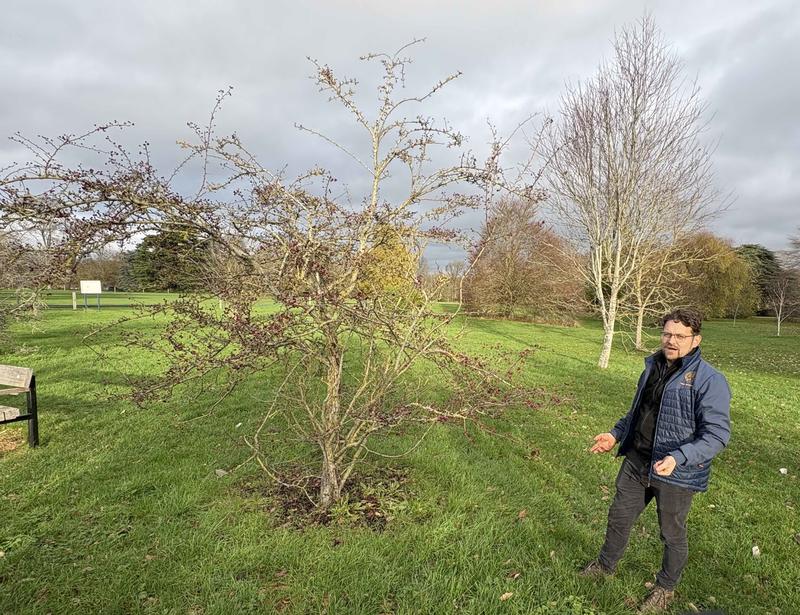
A diffuse sky of watery sun in late November saw Professor Martin Maiden, Professor of Molecular Epidemiology, Head of Biology and a Parks Curator, plant a Hungarian thorn (Crataegus nigra) in a vacant plot on Thorn Walk, a path that runs across the University Parks between Linacre College and Lady Margaret Hall (pictured, right).
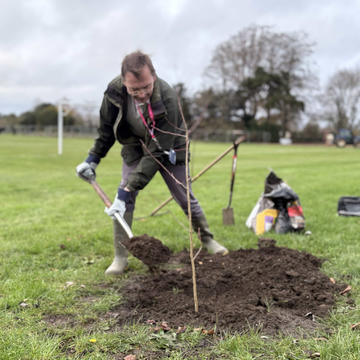
Such a planting is not by itself so rare, but on 27 November the addition of this particular thorn tree, attended by a small crowd with a speech by Professor Maiden, marked the launch of a new Arboretum Explorer Map that aims to transform the visitor experience by unlocking rich detail of individual tree species on a smart phone.
The University Parks, established from 1854, has continuously been cherished and planted by botanists and other arboreally aware ‘plant academics’, resulting today in over 1,900 trees from around 380 distinct taxa.
These span native English plants, some endangered or simply rare, and more exotic specimens from other parts of the world.
There are several ‘national champions’ (where the individual tree is considered the best in class, like an arboreal Crufts winner) and a variety of thematic plantings. For example, you can sample over 30 different hawthorns on Thorn Walk and then turn a corner and encounter a wide variety of oak trees on Oak Walk, and so forth.
Unlocking the rich detail of these remarkable trees has until now been quite difficult for visitors. In the past, inventory booklets were published a decade or two apart, but while they remain very useful as historical snapshots, they were quickly outdated as the collection matured and varied. Trees are not as static as they might appear.
Sam Prior, the University’s Arboricultural Manager who QUAD interviewed earlier in 2025 (lead picture, standing next to one of the hawthorns), says that surveying and capturing the detail of each tree using modern technology is a natural development, but also a necessary prerequisite for the University Parks to claim arboretum status, a current objective.

The Hungarian thorn planted on the day by Professor Maiden is numbered 18773 on an interactive map. You can be standing in the Parks and highlight it with your finger on your phone, and then click into ‘Details’. You then receive an individual photograph of the tree, species detail (Latin and colloquial), site description, size and planting detail (in this case, ‘Newly Planted’; ‘2025’). Finally, there is a note space for any other narrative, in this case documenting Professor Maiden’s contribution.
Alongside these ‘Details’ is a second tab called ‘Eco benefits’ (shown left, for a mature beech tree). As a small shrub this Hungarian thorn is estimated to provide total annual eco-system benefits worth £0.05, if we were to monetise them. That five pence is explained by the estimated annual sequestering of nearly one kilogram of carbon, while other benefits such as intercepting stormwater and removing airborne pollutants are for the time being so negligible as to be non-recordable. That will change if the thorn prospers and grows to a potential six-metre height.
It’s a big contrast if we turn to the Caucasian elm (Zelkova carpinifolia) on North Walk, with a crown that spreads 14 metres and an estimated height of 33 metres, among the tallest trees in Oxford. Numbered 15621 on the map, this tree is estimated to have bound up 18.2 tonnes of carbon worth £1,178.72 if it were to be valued within a carbon trading scenario.
The Caucasian elm, incidentally a national champion, also annually intercepts 10.8 cubic metres of rainwater run-off that might otherwise become a flood.
The data are fascinating not just for their specificity but for reminding us that each and every tree contributes a wide variety of benefits to society, or what are often referred to as ‘nature-based solutions’ or ‘eco-system services’.
These terms of reference are broader than climate and include air quality, floodplain maintenance and water table, the provision of shade and the regulation of temperatures during hot weather. Habitat provision is also part of the value of a tree too.
Subtly but powerfully, as soon as you have played with the interactive map and revealed data for a few trees, it not only becomes immersive but transformative, changing how you view trees from something that might have been ornamental or incidental to a bigger vision. The central dashboard goes even further, collating individual tree benefits into the whole collection, where 1,711 tonnes of carbon are locked up like an arboreal reservoir.
The mapping sits within a website rather than being a fully-fledged app. We found it to work well on a smart phone without Wi-Fi but you need to allow the map to download.
Sam says the next stage in the mapping journey will make everything easier still for visitors to the Parks, because the Parks team will discretely label every tree, providing a QR code that visitors can snap there and then.
‘The label will offer both botanical and colloquial names, natural distribution, an accession or reference number and a QR code. For visitors who leave their phones at home or don’t care for them, it may well be enough.’
For the phone savvy, however, scanning the QR code will bring up the interactive map described above, allowing them to unlock the additional layers of data.
Of course, there remains the delight of discovering a tree you might have never heard of. One that looks very good now is the scarlet oak (Quercus coccinea) on Riverside Walk. Tree 15909 was only planted in 2015 but was originally introduced from Canada and the Eastern USA in 1691. It has flaming red autumnal colour. Other highlights include the Wellingtonias on North Walk, giant sequoias that have reached ages of over 3,500 years and heights of up to 100 metres in California, USA. Then there are the tulip trees (Liriodendron tulipifera, 8805) and the Indian bean tree (Catalpa bignonioides, 13380), both on South Walk.
The map reveals nine national champion trees, among them an ancient hawthorn planted in 1928 (15321, Crataegus x media ‘Rubra Plena’); an Oregon ash, at 20 metres tall a ‘height champion’ (8069, Fraxinus latifolia) and an unusual Chinese weeping poplar (15780, Populus liaotungensis).
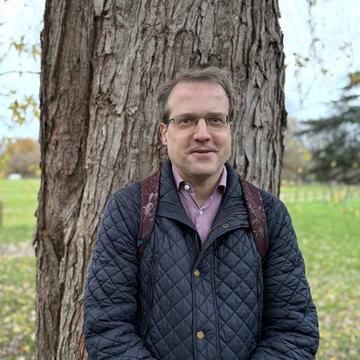
Part of the enormous workload to chart all the trees of the Parks was borne by volunteers from the surrounding Oxford community, one of them Stephen Kenyon (pictured, right), a local tree enthusiast who Sam notes ‘has helped enormously’.
Stephen helped with the hawthorn identification, which is notoriously difficult.
He says that there are over 250 hawthorn taxa and perhaps 1,000 hybrids around the world. That might make the 30-odd species of Thorn Walk sound small until you realise that commercial nurseries in the UK basically supply just two species, hugely reducing the individual diversity that each species brings.
move to carousel movement controls
 Pause slideshow
move to carousel content
Pause slideshow
move to carousel content

OFF THE SHELF: SEPTEMBER 2026
OFF THE SHELF: SEPTEMBER 2026

ELLA BARON
ELLA BARON

THE IMPORTANCE OF VACCINE ADVOCACY
THE IMPORTANCE OF VACCINE ADVOCACY

SILICON VALLEY CAREER TALK
SILICON VALLEY CAREER TALK

DEGREES WORTH IT AFTER ALL
DEGREES WORTH IT AFTER ALL

OFF THE SHELF: AUGUST 2026
OFF THE SHELF: AUGUST 2026

THE RISE OF BACTERIAL RESISTANCE FROM POULTRY FARMS
THE RISE OF BACTERIAL RESISTANCE FROM POULTRY FARMS

NATURAL HISTORY AT OXFORD REVAMPED
NATURAL HISTORY AT OXFORD REVAMPED

OFF THE SHELF: JULY 2026
OFF THE SHELF: JULY 2026

MALACHI MCINTOSH
MALACHI MCINTOSH

EBOLA: FIRST VACCINATION
EBOLA: FIRST VACCINATION
Pause slideshow

