



HOLLY ELLIS
ON PUMAS AND PENGUINS
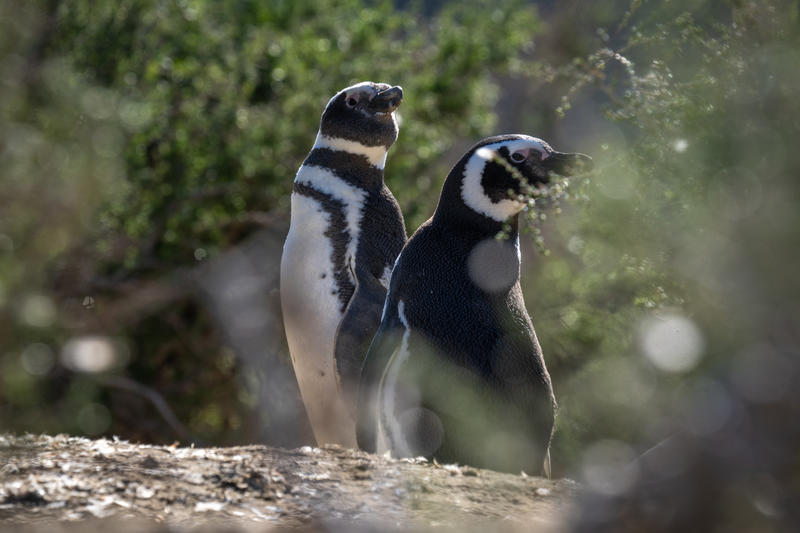
Some Argentinian penguins are experiencing high levels of predation from pumas recolonising their historical territory. A new study involving Oxford researchers, published in the Journal for Nature Conservation, has quantified the risk on long-term penguin population survival.
It’s the oldest conservation dilemma. Should we protect an emblematic species even if at the cost of another one – particularly in ecosystems that are still recovering from human impacts? This is the dilemma facing Monte León National Park, on the Patagonian coast in Argentina.
Since cattle ranching was abandoned in southern Argentina in 1990, pumas (Puma concolor) have been recolonising their historical ranges in this area. For the first time, this brought them in contact with Magellanic penguins (Spheniscus magellanicus) who had moved to the mainland from nearby islands due to the absence of terrestrial predators. Being largely defenceless, the penguins became an easy target for the large carnivore – but it was unknown up to now the exact impact the pumas were having on penguin population numbers.
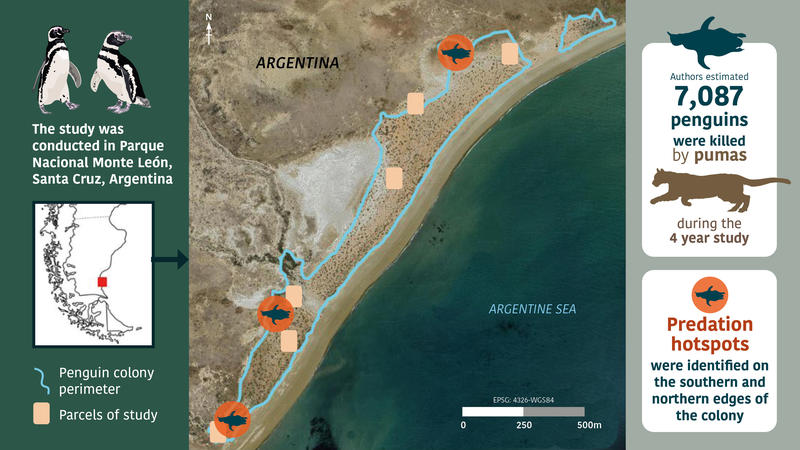
Following its creation in 2004, researchers from the Centro de Investigaciones de Puerto Deseado of the Universidad Nacional de la Patagonia Austral and rangers from the Monte León National Park have monitored the penguin populations in the park. Over four years (2007–10), they counted the number of carcasses caused by puma predation. In the new study, they collaborated with researchers from Oxford University’s Wildlife Conservation Research Unit (WildCRU) to analyse the data.
Based on the numbers of penguins found killed, the research team estimated that more than 7,000 adult penguins were killed over the four-year study, most of which were not fully eaten, indicating that not all the penguins were killed for food. This is roughly 7.6% of the adult population (around 93,000 individuals).
Lead author Melisa Lera, a postgraduate student at WildCRU, said: ‘The number of carcasses showing signs of predation we found in the colony is overwhelming, and the fact that they were left uneaten means pumas were killing more penguins than they required for food. This is consistent with what ecologists describe as "surplus killing". It is comparable to what is seen in domestic cats when prey are abundant and/or vulnerable: ease of capture can lead to cats hunting more birds, even when they do not end up actually eating them. We needed to understand if the penguin colony’s persistence could be threatened due to this behaviour.’
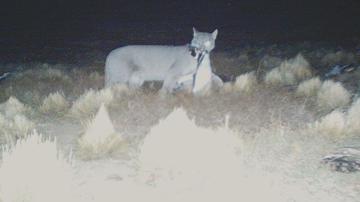
However, when the team modelled the data, this indicated that pumas alone were unlikely to drive the colony at Monte León Park to extinction. Instead, the colony’s future appears to be far more sensitive to factors such as reproductive success and juvenile survival. Population extinction was projected only under hypothetical scenarios combining low juvenile survival (with around 20% failing to reach adulthood) and very low reproductive output (a maximum of one chick per pair). High puma predation was predicted to exacerbate these outcomes.
Study co-author Dr Jorgelina Marino (WildCRU) said: ‘This study captures an emerging conservation challenge, where recovering carnivores are encountering novel prey. Understanding how these dietary shifts affect both predators and prey is essential to inform conservation.’
Since the models identified breeding success and mortality of the juveniles as some of the key determinants of population viability, the authors highlight the need to understand how environmental factors such as nutrients, food and temperature – known to be influenced by climate change – may affect the penguins’ reproductive success.
As terrestrial predators continue to expand into coastal environments, further mainland colonies of seabirds and other coastal species may become vulnerable. For instance, non-native feral hogs are now key predators of loggerhead sea turtle eggs along the Georgia coast, USA, whilst coyotes in eastern North America are colonising coastal barrier islands, with impacts across these ecosystems.
The authors emphasise the need for sustained monitoring to detect demographic declines early and to guide management actions to prevent severe ecological consequences. The park authorities continue to monitor puma and penguin populations.
move to carousel movement controls
 Pause slideshow
move to carousel content
Pause slideshow
move to carousel content

OXFORD'S NEW DEGREE
OXFORD'S NEW DEGREE

SARAH RUDEBECK
SARAH RUDEBECK

OFF THE SHELF: SEPTEMBER 2026
OFF THE SHELF: SEPTEMBER 2026

ELLA BARON
ELLA BARON

THE IMPORTANCE OF VACCINE ADVOCACY
THE IMPORTANCE OF VACCINE ADVOCACY

SILICON VALLEY CAREER TALK
SILICON VALLEY CAREER TALK

DEGREES WORTH IT AFTER ALL
DEGREES WORTH IT AFTER ALL

OFF THE SHELF: AUGUST 2026
OFF THE SHELF: AUGUST 2026

THE RISE OF BACTERIAL RESISTANCE FROM POULTRY FARMS
THE RISE OF BACTERIAL RESISTANCE FROM POULTRY FARMS
NATURAL HISTORY AT OXFORD REVAMPED
NATURAL HISTORY AT OXFORD REVAMPED

OFF THE SHELF: JULY 2026
OFF THE SHELF: JULY 2026
Pause slideshow

