



ELLA BARON
NATURAL HISTORY AT OXFORD REVAMPED

Supported by Biffa Award, the new completed displays opened on 20 July and mark the final phase of ‘Life, as we know it’ – an eight-year programme to transform the presentation of the museum’s collections to visitors.
The ‘Life, as we know it’ project has seen the installation of 48 new displays in 24 state-of-the-art showcases themed around biodiversity, ecosystems, evolution and the Earth. Together, these exhibits encompass the intricate relationships between our planet and life. The redisplay has involved the movement and conservation of thousands of museum specimens to stage them in a fresh, bold design within the stunning main court and unique Victorian building.
Dr Gavin Svenson, the Director of the Museum of Natural History, (below, left) said: ‘“Life, as we know it” has been a long-term effort to rethink how we present the natural world to our visitors, and it is a pleasure to see that vision now fully realised. The new displays bring together thousands of specimens to tell some of the most important stories in science, from the history of life on Earth to the extraordinary diversity of the natural world today. We hope they will inspire curiosity, encourage discovery and help visitors of all ages see their place within the wider story of our planet.’
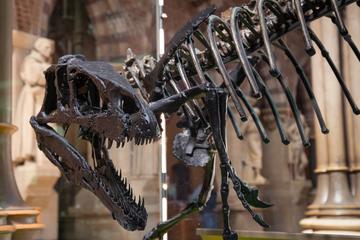
At the heart of this final phase of ‘Life, as we know it’ is Megalosaurus, a Jurassic dinosaur discovered in an Oxfordshire quarry in Stonesfield in the late 18th century. It became the first dinosaur ever to be scientifically named when University of Oxford Professor William Buckland presented its fossilised remains to the Geological Society of London in 1824.
Megalosaurus – meaning ‘great lizard’ – is recognised as kick-starting the study of what would collectively come to be known as dinosaurs (‘terrible lizards’). Measuring nine metres in length and weighing around a tonne, the fossilised remains of the world’s first dinosaur – including the iconic lower jawbone – will form part of the new prehistoric ecosystems displays.
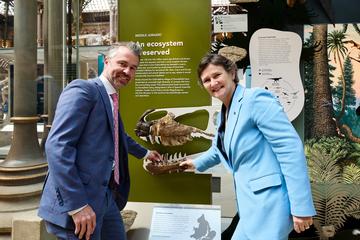
Alongside Megalosaurus will sit a related genus, Eustreptospondylus, a predatory dinosaur discovered in Summertown, Oxford, in 1870 (above right). This cousin of Megalosaurus will be exhibited for the first time as a fully articulated skeleton, using a combination of original fossil material, digital modelling and 3D printing, created in collaboration with the University of Chicago.
These new dinosaur displays conjure the deep past of Oxfordshire, where rocks contain a prehistoric landscape frozen in time. Around 166 million years ago, during the Jurassic period, dinosaurs crossed a vast muddy plain leaving behind fragments of skeletons, fossilised remains and hundreds of footprints that would eventually turn to stone. A ‘dinosaur highway’, excavated by experts from the museum at a farm in Ardley, Oxfordshire, in 2024, made headlines worldwide. Several different dinosaur footprints were revealed during the dig, including the distinctive three-toed claws of Megalosaurus. A 60-metre-long sequence of Megalosaurus footprints cast from fossilised prints can also be seen crossing the lawn in front of the museum.
A third Oxfordshire dinosaur, Cumnoria, named after its discovery in Cumnor in 1879, is displayed sinking through the ocean to its final resting place in a showcase on fossilisation.
The new exhibits will track the history of our planet, showing how life and Earth exist in a dynamic relationship, each shaping the other. Visitors can experience a tactile connection to these themes through a series of touchable mineral specimens, as well as a new installation, Mirror Moon, created by artist Luke Jerram. The one-metre diameter polished steel sculpture presents a reconstruction of the Moon’s surface, formed using accurate topographic data from NASA. Visitors will be able to feel every crater, valley and mountain.
This final phase of ‘Life, as we know it’ also includes an innovative new digital interactive, Prehistoric Diver, which recreates ocean ecosystems from the Jurassic era and even further back in time to the Cambrian period, an age of rapid evolution 500 million years ago. Prehistoric Diver will explore these lost worlds, placing visitors at the helm of a virtual submarine scanning the seas for ancient lifeforms.
Founded in 1860 as the centre for scientific study at the University of Oxford, the world’s first purpose-built museum of natural history now holds the University’s internationally renowned collections of natural history specimens and archives. Housed in a much-loved neo-Gothic building, the museum is free to enter and its growing collections underpin a lively programme of research, teaching and events focused on the sciences of the natural environment.
The final phase of ‘Life, as we know it’ has been generously supported by Biffa Award, a fund that helps to build communities and transform lives across England and Northern Ireland as part of the government's Landfill Communities Fund. Previous phases of the redisplay project were supported by the FCC Communities Foundation.
Oxford’s gardens, libraries and museums are among the most visible ways in which the University shares its research and collections with the wider public and were enjoyed by a record 3.8 million visitors in 2025. The completion of ‘Life, as we know it’ is a remarkable achievement that brings together cutting-edge science, outstanding collections and public engagement, helping new generations of visitors explore the history of our planet and the extraordinary diversity of life upon it.
Watch the video to get a dynamic overview of how the Natural History Museum has been transformed
https://www.youtube-nocookie.com/embed/1s0cm6-Wc6Y?si=2g2ni8uq3FJ1uFta
move to carousel movement controls
 Pause slideshow
move to carousel content
Pause slideshow
move to carousel content

THE IMPORTANCE OF VACCINE ADVOCACY
THE IMPORTANCE OF VACCINE ADVOCACY
SILICON VALLEY CAREER TALK
SILICON VALLEY CAREER TALK

DEGREES WORTH IT AFTER ALL
DEGREES WORTH IT AFTER ALL

OFF THE SHELF: AUGUST 2026
OFF THE SHELF: AUGUST 2026
THE RISE OF BACTERIAL RESISTANCE FROM POULTRY FARMS
THE RISE OF BACTERIAL RESISTANCE FROM POULTRY FARMS

OFF THE SHELF: JULY 2026
OFF THE SHELF: JULY 2026

MALACHI MCINTOSH
MALACHI MCINTOSH
EBOLA: FIRST VACCINATION
EBOLA: FIRST VACCINATION

GRAPPLING WITH THE GHOSTS OF CARIBBEAN COLONIALISM
GRAPPLING WITH THE GHOSTS OF CARIBBEAN COLONIALISM

ADAM SMITH
ADAM SMITH
CONSERVATION AND WAR STUDIES JOIN HANDS
CONSERVATION AND WAR STUDIES JOIN HANDS
Pause slideshow

