


OXFORD'S NEW DEGREE
HOLLY ELLIS
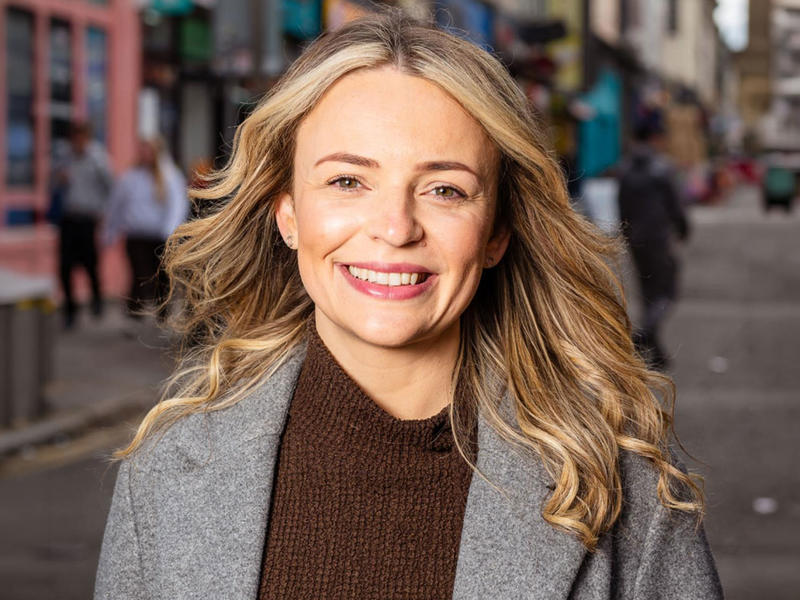
Self-styled ‘The Scouse Scientist’ Holly Ellis (St John’s, 2011) studied biology at Oxford, and besides further degrees entered the NHS as a rising scientist, today a Principal Clinical Scientist in Genomics, based in her native Liverpool.
Now married with a daughter, Holly has also carved out a brilliant social media presence smashing all manner of prejudices around both Oxford and science, and being a woman, and speaking unapologetically (and gloriously!) in Scouse, the colloquial term for a Liverpudlian accent, derived originally from ‘lobscouse’, a popular meat stew eaten locally.
Her motto is ‘if you see it, you can be it.’
She began a recent Tedx Talk (Teeside) by showing a picture of the science building at her original comprehensive school, Holly Lodge Girl’s College, which had been named after the brilliant chemist and pioneer of DNA breakthroughs, Rosalind Franklin (1920-58).
She notes to the live audience that for almost five years she went in and out of the building barely noticing its name, and not knowing who Rosalind Franklin was. Finally the penny dropped, and more than that, the further knowledge that Franklin’s own contribution to what became a Nobel Prize winning discovery was not credited to her as it should have been.
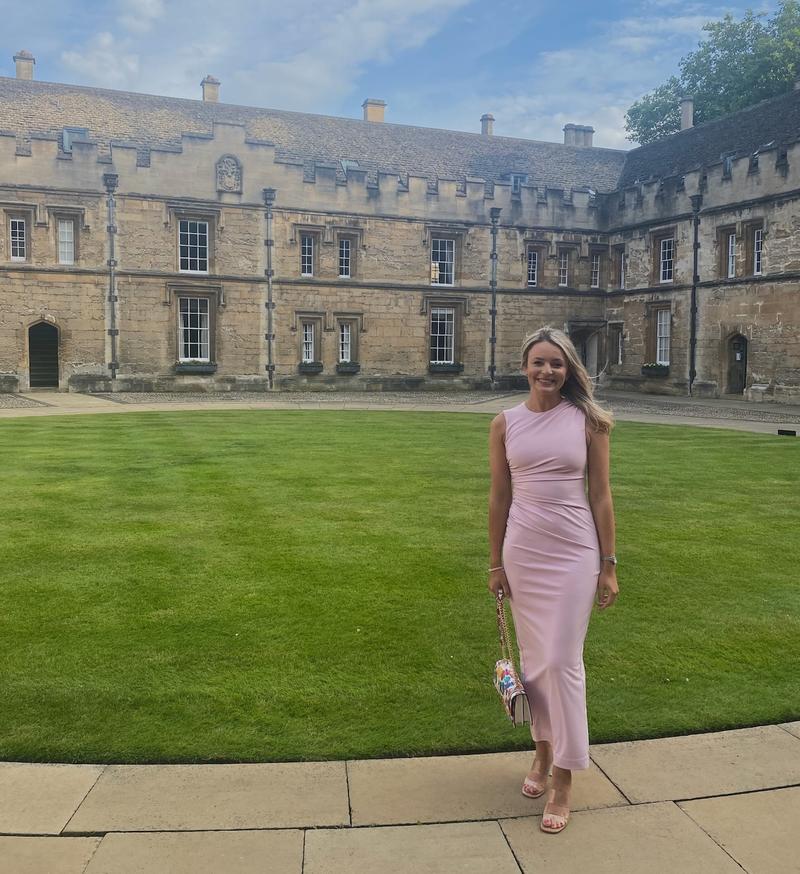
The talk goes on to imagine what many people might imagine a scientist to be – the white coated, white male, maybe with crazy hair.
But there she is, a blond Liverpudlian in a glamorous pink dress, telling the same audience that she is a scientist and then going on to explain what DNA is, and what the field of genomics can offer by way of incredible healthcare breakthroughs.
‘I’ve got a strong ability I think to translate complex ideas into simple, memorable examples,’ she offers.
One example given in the Tedx Talk is how pharmacogenomics (‘Using genomic information to predict how someone might respond to a particular drug’) has led to transformational practices across a wide range of fields, allowing pre-testing of drug responses ahead of the main treatment, saving the lives of patients who would otherwise have suffered a potentially fatal reaction owing to a genetic quirk.
Another example concerns how decoding the human genome has greatly benefitted acutely unwell babies born with an unknown illness. Previously, identifying the genetic cause and subsequent treatment plan could take years and was known as the ‘diagnostic odyssey’, but recent advances in genomics can provide these babies with a diagnosis in a matter of days.
Holly says that her lab is currently involved in a NHS pilot study to identify whether it is beneficial to test for 200 genetic conditions at birth, enhancing the current heel prick test that currently screens for nine conditions. She says that for a condition such as spinal muscular atrophy (SMA), a rare genetic condition that causes progressive muscle weakness and wasting, early detection saves the life of the patient, allows early treatment and in addition potentially saves the NHS vast sums of money that would otherwise have been spent on constant treatments across a lifetime. It also greatly enhances the life prospects of the patient.
We turn to Holly’s time at Oxford, and how she got there in the first place.
She says that a teacher strongly encouraged her to take Further Science at the point that she chose her GCSEs, when she was focused mostly on dance and art. Another teacher urged her to consider her future career direction when she achieved 100% in a biology test, almost unheard of.
A naturally effervescent, determined sense of direction took over and she applied to selective but non-fee paying grammar school Blue Coat and got in for her A-Levels. That led to an Oxford visit.
‘I had fun with my friends on the visit but had no intention of applying. In the end my mum said, ‘well you might as well apply, see where it goes.’ The in-person interview was held at her first choice college St John’s, which duly accepted her for Biological Sciences.
Memorably, not happily, she remembers coming down to Oxford the night before her first day with her mum and her nan, all three of them staying in the Youth Hostel by the railway station (since then demolished to make way for the new Botley Road bridge).
‘I cried that night – I thought I had made a huge mistake. My mum said: get through one week and if it doesn’t work out I’ll come back and collect you.’
‘I made friends in that first week, and my mum did come down in case, but I was OK. I stayed.’
She then had an absolutely amazing time and decided early on not to hide or dilute her Scouse accent, but to be exactly who she was.
‘It became a point of difference I guess, I was memorable to the scouts, the porters, the academics…’
She also realised very early on that if she shunned people ‘not like her’, it would be acting out in reverse exactly the prejudice that she feared would be applied to her. ‘I quickly made friends with a wide range of people from many backgrounds.’
Since returning to Liverpool and commencing a significant social media offensive to flatten negative prejudice, she says she constantly has to convince other Liverpudlians that Oxford was a great time, with great people.
Holly has set out nothing less than to advance a mission to batter down unfair prejudice wherever it sits, whether in Liverpool against Oxford, or Oxford against Liverpool, or its many equivalents everywhere. All completely unnecessary.
‘I won a St John's music bursary having passed Grade 8 on the piano before Oxford, so it allowed me to continue with lessons. I attended St Aldate’s church and enjoyed that, and the music there. Dancing was a big hobby too and the summer balls – there is a cross-over between the glamming up we’re known for in Liverpool and putting on a ball gown for a commemorative ball.’
Marriage and then time away for maternity leave to nurture her daughter Ada led to a quiet moment for The Scouse Scientist social media identity begun in 2019. But it also led Holly to double down on it since 2025, once a structure was in place for work and family life.
Her main focus in 2026 has been her YouTube-based podcast, also called ‘The Scouse Scientist.’
The first series was broadcast earlier this year under the collective title ‘But you don’t look like a scientist.’ She says she is recording her second series right now and pulling in a deliberately, wildly diverse group of scientists from space engineering to medicine, across the range of Science, Technology, Engineering, and Mathematics (STEM).
STEM subjects still suffer from intense gender disparity, just 20% female she explains.
‘I am convinced that one of the main contributing factors to this is a lack of relatable role models.’
Holly says that one of her goals is to host her own TV show for kids, ‘and change the face of science.’
Taken on by an agent after a video clip went viral (she was talking to Radio Merseyside, and it is pinned on her Instagram feed), and after attending a series of prestigious conferences, she has been appointed as an expert commentator for BBC Morning Live. This means being available to comment on stories about genetics and genomics when they arise in the public domain.
Her message back to Oxford is twofold: gratitude for an amazing experience but also a plain and simple request that when the University creates promotional videos of current students discussing what the place is like for prospective students, that they might sound different as well as look different (‘they invariably sound the same no matter who they are!’).
This leads us to a speculative discussion about regional accents discarded in Fresher’s Week and closely guarded thereafter, perhaps for life. ‘I noticed that some of the other students tamed their regional accents to fit in at Oxford,’ she recalls.
Her advice to all people and perhaps especially non-Southern prospective students at Oxford, is ‘to be authentically and unapologetically yourself, rather than contorting yourself to ‘fit in.’' She adds, ‘I chose not to be offended by some of the reactions I got…’
move to carousel movement controls
 Pause slideshow
move to carousel content
Pause slideshow
move to carousel content
SARAH RUDEBECK
SARAH RUDEBECK
OFF THE SHELF: SEPTEMBER 2026
OFF THE SHELF: SEPTEMBER 2026
ELLA BARON
ELLA BARON
THE IMPORTANCE OF VACCINE ADVOCACY
THE IMPORTANCE OF VACCINE ADVOCACY

SILICON VALLEY CAREER TALK
SILICON VALLEY CAREER TALK

DEGREES WORTH IT AFTER ALL
DEGREES WORTH IT AFTER ALL

OFF THE SHELF: AUGUST 2026
OFF THE SHELF: AUGUST 2026
THE RISE OF BACTERIAL RESISTANCE FROM POULTRY FARMS
THE RISE OF BACTERIAL RESISTANCE FROM POULTRY FARMS
NATURAL HISTORY AT OXFORD REVAMPED
NATURAL HISTORY AT OXFORD REVAMPED

OFF THE SHELF: JULY 2026
OFF THE SHELF: JULY 2026
MALACHI MCINTOSH
MALACHI MCINTOSH
Pause slideshow

